
Monday, December 2, 2013

Global Education At A Crossroads

Since the 1970s, there has been a long struggle to have global education accepted as part of the curriculum and as a subject for serious study. Since 9/11, despite the upshot in interest all things global, the states and the federal government have lacked sustained interest to push for more global education in the curriculum.
In 2008 the standards of only two states, Maryland and Mississippi, contained the term “global citizenship.” Remarkably, the Common Core standards pay only a glancing attention to global issues. Maryland was the only state to receive “Race to the Top” funding that included international education and global citizenship in 2011.
Generally, what has occurred over the half century that spans the term’s first use in the 1970s until today is an increased number of teachers who are experimenting with making their classrooms more global -- but no commensurate increase in the number of schools or school districts that could be termed fully global in nature. Nowadays, when schools or districts reference global issues, it is often done in the context of promoting something referred to as “global competence” or even more nebulously "21st century skills." The terms sound appealing, particularly to the business community that sees both as embracing the need for workers equipped with both foreign language and STEM skills. But it strips out the core meaning why many of us first got involved with global education movement: the need for students to truly understand people from other cultures.
To do this effectivelyas much of the research since Hanvey wrote his masterful essay, “An attainable global perspective,” bears out, is to collaborate with people from other parts of the world. Following the growing sophistication of online tools such as Skype and services such as iEARN and ePals, these approaches are now more widely available but to tend to require a deeper, longer-term commitment on behalf of teachers than many of them can nowadays afford to give. Such teachers are in danger of becoming marginalized, as classroom time is ever more taken up with teaching only what is measurable and they find alack of support for the more difficult to quantify cultural skills that students only learn through such longer term collaborative efforts. As a result of these developments, the global education movement faces an uncertain future.
For global education to grow as a field and not just survive, individual teachers who care about creating the next generation of world-minded students need to collaborate together through social networks or forums such as the global education conference affords to make clear their core principles. They need to work with their colleagues to help their entire schools become global, with sustained partnerships that help enrich the curriculum across disciplines and grade levels. To make progress we will need to extend and expand our discussions from beyond our fellow “true believers” to include our fellow teachers and school leaders as well as parents and community leaders. The field will need to examine areas where it can have greatest impact. Working towards an aspirational goal of creating global 21st-century citizens will require entire schools to develop partnerships with counterpart schools around the globe that can be sustained -- so that when one globally minded teacher leaves, the entire program does not then disappear.
For this type of vision to be sustainable, we will also need university partners who can evaluate the harder-to-measure metrics connected with what it means to move from an awareness of different cultural perspectives to a willingness to act as a global citizen and provide the all important preservice and inservice professional development that is today so noticeably lacking.
Activities such as those during Connected Educator Month and the Global Education conference are a start in the right direction.

Thursday, November 21, 2013

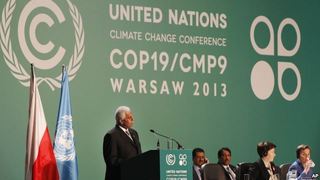
Lack of Coverage of Warsaw Climate Conference Does Not Bode Well


The devastation from the recent typhoon that hit the Philippines according to the country's lead negotiator at the United Nations climate summit in Warsaw, Naderev Sano,“was [like] nothing we have ever experienced before, or perhaps nothing that any country has ever experienced before”.
Despite the thousands of people killed and Sano's plea to nations to act on climate change and prevent super typhoons such as Haiyan, from becoming “a way of life” the UN Conference on Climate change in Warsaw seems currently deadlocked.


The UN climate change summit going on now in Warsaw might as well be occurring on an alternative universe. There is no coverage in the mainstream press.  The news today of a walk out among
"hundreds of environmental activists  over the absence of a binding agreement on curbing global warming coming on the heels of a group of 133 developing nations walking out of a key negotiating meeting about how much of the burden developed economies must pay for the cost of the damage they have caused seems to suggest deadlock is now inevitable. According to one source

"The paper makes it clear that, despite President Barack Obama's progressive stances on climate issues over the past year, the US continues to pose difficulties to closing an international global climate deal by strongly resisting the concept of historical responsibility for emissions and positioning itself in opposition to developing countries on the main issues at stake."

The memo is indicative as to how many western governments are now turning their backs on climate change. As the Guardian has reported,

"Recent decisions by the governments of Australia, Japan and Canada to downgrade their efforts over climate change have caused panic among those states most affected by global warming, who fear others will follow as they rearrange their priorities during the downturn.

In the last few days, Japan has announced it will backtrack on its pledge to reduce its emission cuts from 25% to 3.8% by 2020 on the basis that it had to close its nuclear reactors after the 2011 earthquake and tsunami.

Australia, which is not sending a minister to this weekend's talks, signaled it may weaken its targets and is repealing domestic carbon laws following the election of a conservative government.

Canada has pulled out of the Kyoto accord, which committed major industrial economies to reducing their annual CO2 emissions to below 1990 levels.

These governments as well as the US have been allowed to get away with it by a compliant media that is owned in large part by corporate interests. If there is to be real change in terms of addressing the climate crisis it has to come from the grassroots.  Even though the NGOs are walking out of Warsaw only after mobilizing a sleepy public and a negligent media.


Monday, October 21, 2013

Democrats Need to Go on The Offensive

Despite the travesty of the Republican led government shutdown the GOP is still controlling the debate in Washington.As George Packer writes in the New Yorker"These days, Republicans may be losing politically and resorting to increasingly anti-majoritarian means—gerrymandering, filibuster abuse, voter suppression, activist Supreme Court decisions, legislative terrorism—to nullify election results. But on economic-policy matters they are setting the terms. Senator Ted Cruz can be justly described as a demagogic fool, but lately he’s been on the offensive far more than the White House has. The deficit is in fairly precipitous decline, but job growth is anemic, and millions of Americans remain chronically unemployed. Democrats control the White House and the Senate, and last year they won a larger share of the national vote in the House than Republicans did. And yet the dominant argument in Washington is over spending cuts, not over ways to increase economic growth and address acute problems like inequality, poor schools, and infrastructure decay."As Larry Summers has stated recently in the Financial Times" budget deficits are now a second-order problem relative to more pressing issues facing the US economy. Projections that there is a major deficit problem are highly uncertain. And policies that indirectly address deficit issues by focusing on growth are sounder economically and more plausible politically than the long-term budget deals with which much of the policy community is obsessed. The latest Congressional Budget Office projection is that the federal deficit will fall to 2 per cent of GDP by 2015 and that a decade from now the debt-to-GDP ratio will be below its current level of 75 per cent. While the CBO projects that under current law the debt-to-GDP ratio will rise over the longer term, the rise is not large relative to the scale of the US economy. It would be offset by an increase in revenues or a decrease in spending of 0.8 per cent of GDP for the next 25 years and 1.7 per cent of GDP for the next 75 years."So why the disconnect between the political conversation that should be dominated by facts and not by Republican talking points?   A lack of White House leadership seems the best explanation.  As Maureen Dowd puts it well in yesterday's New York Times, this is a President who is too fond of being above the fray,"Obama’s default position is didactic disdain. He underuses the fear and charm cards. When he first saw the White House movie theater, he was surprised there were so many seats beyond what the first family would need. Bill Clinton, on the other hand, probably would have built a balcony and auctioned off seats, if he could have.As Valerie Jarrett told David Remnick in “The Bridge,” Obama’s “uncanny” abilities need to be properly engaged, or he disengages. “He’s been bored to death his whole life,” she said. “He’s just too talented to do what ordinary people do.”The worst part about the situation is that the White House will not allow other talented people do anything either.  Perhaps they are too caught up in the health care exchange failure but this cannot be the entire explanation. The President so controls the message that they will not allow other potential spokespeople, notably his Secretary of Labor to take center stage in the way that Robert Reich was allowed to do in the Clinton administration. The Democrats in Congress too seem in a cowering position as if they just want the Republicans to return to the old centrist party they once were and feel they might get rewarded for good behavior if they play on their turf.  If Obama is really serious about preserving jobs and growing the economy he should repeat over and over again that the deficit is not the issue, the problem is growth. He should be out front on this debate instead of gaming the next potential shutdown in January when Republicans will demand cuts in social programs and refuse to allow tax increases on billionaires. You cannot win when you don't engage. 


Wednesday, September 4, 2013

Is Obama Squandering his Legacy?


In July Obama visited  Knox College in Galesburg Illinois and told the audience that he cared about “one thing and one thing only, and that’s how to use every minute of the 1,276 days remaining in my term to make this country work for working Americans again,” but now Obama is so boxed in with regard to Syria that it is highly unlikely that many of those days will now be devoted to delivering on that major goal.  This will be unfortunate as the slow crisis that has been building since the implosion of the economy under reckless mismanagement by the former president, his friends on Wall Street and enablers in Congress, is now stealing the futures of the young. The portion of people aged 20-24  who have jobs has fallen from 72.2 percent in 2000 to just 61.5 percent, while adjusted for inflation, their median earnings has fallen by nearly 30 percent since 1973 and women, the median by 17 percent.  Meanwhile the average net worth of the wealthiest seven percent of households climbed by 28 percent. The effects on the next generation will be even more severe. In 2011 nearly one third of all children lived in a household where no parent had full-time year round employment while half of all children in urban centers experience unstable family employment.  As a recent ETS report points out “only Romania has a higher child poverty rate than the US." This is shameful for a nation that claims to be a world superpower. There is no use to pretending either that these numbers don't translate into significant gaps in achievement between rich and poor particularly in cities where continued segregation compounds the problem. As the recession continues income and educational equality will make the lives of poor families even worse as 26 states provide less funding per student to local school districts in the new school year than a year ago.

Syria is a huge distraction from the battle to focus people’s attention on unemployment and underemployment.  A Syrian operation will likely cost several billion dollars just a few of those dollars could be spent to raise the minimum wage. How can you justify paying workers who support families wages that cannot support those families so that they have to apply for food stamps ? These are not handouts. The minimum wage in 1963 when Martin Luther King marched for jobs and justice was held constant for inflation it  would now be $9.40 an hour in today’s dollars, not $7.25. Rather than wasting his political capital on rounding up Congress to authorize a dubious strike with a dubious legal basis he should be raising the minimum wage to reignite his flagging presidency. Doubtless MLK, Obama's hero, as he declared so passionately on the grounds of the Lincoln Memorial this month, would have supported the fast food workers. As their strikes move to more cities he could allow his inner MLK to sign an executive order to raise the minimum wage and rescue at least some of the workers caught in today's  economic vice. On Syria he should follow Jane Harman’s advice and get Russia on our side, “If Russia would align with us on stopping all the butchery, that would be an important change, and Russia’s not there. For Russia to be on the wrong side of the use of chemical weapons is stunning, and we’re just not calling them out adequately. Our recent track record with Russia has not shown many results, but I think pulling the international community together to shame Russia is something we should be doing. We should use the leverage we have. The G20 is happening [September 5-6] in Russia. I would look at the G20 and at the United Nations General Assembly as two places where the international community comes together. It should be G19 against G1 going into Russia.”

For Obama to squander his last year and a half in this way will not help his legacy and set back the hopes of a generation.

Thursday, August 29, 2013

Why The Rush to "Retaliate"?

We have had two wars in the past two decades and they both started through murky if not dishonest reasoning. We now hear the drum beat again to start prompting allied action in Syria. Why the rush?  As Hans Blix notes in an interview with the Huff Post,


"As far as they are all concerned, a criminal act has been committed so now they must engage in what they call "retaliation." I don't see what they are retaliating about. The weapons weren't used against them. It should be the rebels who want retaliation. If the aim is to stop the breach of international law and to keep the lid on others with chemical weapons, military action without first waiting for the UN inspector report is not the way to go about it. This is about world police, not world law."
You may recall the Bush administration went out of its way to discredit Blix and he returns the favor nicely by exposing the flaws in this latest crop of world leaders' reasoning .  The British public at least seem to have learned the right lessons from recent history with respect to middle eastern conflict and they have  no desire to repeat the same moronic behavior. As Cassidy notes in in his  New Yorker blog, widespread  opposition to Syrian action is cooling Cameron's  desire to play Blair's role in agreeing to follow the Americans, 
"Britons are against military action by a majority of about two-to-one, and the skepticism extends to many supporters of the Conservative-Liberal coalition. In recent days, the voters have been besieging their M.P.s with phone calls and messages, and their protests have had an effect. “Grateful for all the emails I’m receiving from constituents about Syria,” the Conservative M.P. Zac Goldsmith wrote in a tweet on Wednesday. “Unlike so many cut-and-paste jobs, they are authentic & heart-felt.”
Maybe giving the UN a chance to vote on any action might be a good start. If you want to play world policeman and want a world of laws you cannot ignore the one body entrusted with the right to authorize military action under these circumstances. 


Thursday, August 1, 2013

New Book Out! Planet in Peril: Young People to the Rescue

I am very pleased to announce the publication of my new book, Planet in Peril: Young People to the Rescue you can find it on Amazon Kindle among many other venues.Why did I write this book? First because the news headlines concerning the future can make young people especially if not the rest of us feel gloomy and even despondent about the future.

Young people in particular find it harder to separate off their own futures from the general gloom. While a gifted environmental science or social science teacher can give them a perspective on topics like global warming and the many calamities to come, too often the discussion is framed far too abstractly. I wrote this book because students need and want to comprehend their own role and place in this unfolding drama. Without understanding their own sense of agency students can all too often feel depressed and tune
out. But how do students gain this sense of agency? In my view it is through understanding people like themselves acting in the world and working to realize their own goals and following their own core values. My second reason for writing is that for a while now I have been frustrated by the gap between the rhetoric applied to various school reform initiatives and the reality. The rhetoric of why we must change our traditional teacher and text book centered classrooms and embrace more global realities has been in place at least since the cold war ended in the 1980s if not before. Yet despite the introduction of computers that can link any classroom to anywhere around the world, we have been relatively slow in using technology to exploring our global identities, preferring the safety and security of our still quite insular textbooks and the traditional approaches to the curriculum that they so often favor. The latest effort of our still quite insular textbooks and the traditional approaches to the curriculum that they so often favor.  A third and final reason for writing this book is my deep conviction that if we are truly to survive as a species we will need to be able to exhibit a new ethic of cooperation and collaboration that can surmount race and nationality. Young people I have met instinctively understand this and yet in their classrooms they are not shown enough people who may not look like them or sound like them who also want to make a difference on behalf of our common humanity. As the world gets smaller and we all get connected on Facebook and other social networks, we need to do more to show our young people the ways they can make a difference by using their voices to affect positive change in the world.

You can find the book at the following E-Reader Sites--

On Amazon


On Nook

Thursday, June 20, 2013

Sugata Mitra: We Are Just at the Beginning of Exploring the Web's Potential for Education

I have been following Sugata Mitra' work since I discovered his Hole in the Wall experiment in which he left a working computer in a hole in the wall of a remote Indian village and observed how the children taught themselves how to use the machine. This was ground breaking work that Mitra classifies under the academic sounding title 'self organized learning.'  The work provoked some mild interest and a spell binding TED talk that earned him a $1 million dollar prize in 2013 but not much else(as Mitra notes in a Guardian article) seems to have changed in the educational landscape. Mitra seems frustrated by the problem but has not stopped experimenting. His most recent innovation is the Granny Cloud--that has involved a group of volunteer teachers from the UK and a few other countries  who have been connecting to poor schools in India and South America for more than five years, "using a combination of the internet and admiration to provide a meaningful education for children."The grannies, or e-mediators as they are officially known, are not teachers, and the sessions they conduct with the children in India are not lessons. Instead, they read stories to the children and talk about things relevant to them and to the U.K. They encourage, praise and became a "virtual granny" to these Indian children. The granny idea emerged when after he saw students learning grow using the computer alone he brought in a " 22-year-old woman with no knowledge of the subject to tutor the kids, using “the method of the grandmother.” Instead of traditional instructing, she simply gave encouragement. The kids’ test comprehension scores jumped. There are around 300 "grannies" involved in the scheme and is growing all the time." What a good idea.  As Mitra states

"We don't need to improve schools. We need to reinvent them for our times, our requirements and our future. We don't need efficient clerks to fuel an administrative machine that is no longer needed. Machines will do that for us. We need people who can think divergently, across outdated "disciplines", connecting ideas across the entire mass of humanity. We need people who can think like children."

Mitra's major point is that we need to reinvent schooling based on the notion that the kind of superficial learning that school encourages can be mastered in a few minutes by children using the web


"The curriculum lists things that children must learn. There is no list stating why these things are important. A child being taught the history of Vikings in England says to me: "We could have found out all that in five minutes if we ever needed to."
What the Internet has really allowed in classrooms is what do we do with the knowledge once we find it ---how does it apply to real world problems. How can we devise new solutions. What does it mean for example that we are entering a period of planetary unsustainabilty?   We as teachers have been given a gift--we still seem to be struggling to know how to use it.