So Google avoids US and UK taxes among a host of other countries that it shorted--what a shocker! The company that has the motto "do no evil" has managed to pay only a fraction of the tax it owes. In the US it comes to about $3.1 billion the company has avoided and in the UK the amount is estimated to be more than a £100m. This practice of shipping money off-shore is common among the multi-nationals that feel they owe their shareholders the responsibility of maximizing profits ahead of tax obligations to any individual countries. The effective tax rate Google paid was 2.4 percent rather than the average of 20-25 percent that was really due. If we all enjoyed that rate what fun life would be. As Tapped, American Prospects' blog states
"It did so not just by taking advantage of tax breaks available to corporations for research and development, depreciation and the like, but also by more dubious techniques known as the "Double Irish" and the "Dutch Sandwich" -- “the sandwich leaves no tax behind to taste." These tactics involve shuttling earnings through various foreign subsidiaries with no business purpose other than tax evasion.
The American Prospect asks whether this action was "evil" and answers as follows:
"If Google's definition of not being evil is 'doing more than the average corporation to support the public interest,' then sure it is. It's one thing to take advantage of legitimate tax law, but exploiting these loopholes for the sole purpose of paying less tax violates the spirit of the law, if not the letter. That would be fine if Google was content as a typical business, relentlessly pursuing profit with no thought to the public interest. They simply shouldn't pretend they're somehow better than the Exxons and Goldman Sachs of the world."
The issue is symbolic of the uneasy relationship that exists between powerful multinational corporations and sovereign governments. As governments lose power and global corporations gain it becomes difficult for any single governmental entity to control their excesses. As Steve Pearlstein notes in today's Washington Post only a few days before:
"President Obama made an offer that no one in the business community seems to have picked up on. The "anti-business" president said he supported the idea of reducing the corporate tax rate to a more globally competitive level - 25 percent is the number frequently mentioned - but only as part of a package that tightened rules on inter-company transfers and eliminated enough corporate tax breaks so that there was no overall reduction in revenues or increase in the federal deficit."
Despite some bipartisan support there chances that this will occur are slim as Pearlstein notes reducing the rate down even by a few percentage points will not win the support of companies as large as Google since their dodges are extremely lucrative;
"Right now, it's big global companies like Google that have the most to lose if rules are tightened and tax breaks eliminated, while smaller domestic firms would gain most from a reduction in the rate. Similarly, companies in the insurance, pharmaceutical and energy sectors probably benefit disproportionately from existing tax breaks that do little for profitable companies in retail, distribution, manufacturing and business services. If history is any guide, the odds are that certain losers will out-shout and out-lobby the potential winners.The conventional wisdom is that it will take presidential leadership to reform the tax code and balance the budget, but the reality is that it will require the support of the business community. Up to now, the refrain from the corporate sector has been almost exclusively, "What's good for business is good for America." Are there no leaders left in the boardroom who still believe it works the other way around?"
We badly need an informed debate about the role of global corporations which might lead to a code of ethical behavior that can be monitored carefully based on transparent information. The media at the moment show very little interest in this issue, this maybe due to the fact that so many of the large ones are owned by business conglomerates that are well versed in the tax dodges themselves.
Friday, October 29, 2010
Wednesday, October 13, 2010
Chilean Miners--A Global Opportunity to Unite?
One amazing thing about the brave Chilean miners rescue drama was that if you turned on US TV last night and this morning you would see uninterrupted coverage of one miner after another emerging sunglassed from their hellish underground location to be greeted by his overjoyed family. For the US to give up “regularly scheduled programming” for anything let alone a foreign mine disaster for such an extended period is highly unusual and worthy of some comment. When we taken into account that a 1,000 strong press corps is situated at the mine representing over 30 countries we seem to have approached a McLuhanesque global village moment. .The last time something like this happened was possibly the Moon landing. What made this event so important not just for a headline or two but for continuous TV coverage? The human story of course which transcends borders–there was no thought of rescue of anyone for 17 days before the famous note was found written in Spanish in red ink, it read simply: "The 33 of us are fine in the shelter."
But there was also another story to be told about the international cooperation that went into the rescue as the LA Times reports:
“Twenty private mining companies from around the world — usually rivals — coordinated efforts to penetrate the rock, loaning equipment and personnel; the state-run mining company fashioned a telephone system through a second probe hole. The U.S. National Aeronautics and Space Administration sent a team to Chile to share expertise about the psychological and physical toll of living in cramped quarters, and when the miners exercise — to be rescued, they must fit into a capsule called the Phoenix, whose diameter is less than two feet — they wear gear that is standard for astronauts and which monitors their heart, lung and other functions. When they are finally brought out into the light they will wear special sunglasses provided by Oakley, based in Orange County..”
We also learn that “long-time enemies Bolivia and Chile are cooperating to support Bolivian miner Carlos Mamani, 23, and Bolivia's leftist President Evo Morales is expected to greet the newly freed miners along with Chile's conservative President Sebastian PiƱera..”
It is also reported that “work crews have raised the flags of Canada, the US, and Argentina, among others. Palestinian ambassador Mai Al Kaila visited the site, adding her flag to the collection.”
So let peace light and global cooperation spread ! Perhaps this incident will lead to globally recognized standards concerning mine maintenance and worker safety so that future incidents (most sadly the recent tragedy in West Virginia) can be avoided.
.
But there was also another story to be told about the international cooperation that went into the rescue as the LA Times reports:
“Twenty private mining companies from around the world — usually rivals — coordinated efforts to penetrate the rock, loaning equipment and personnel; the state-run mining company fashioned a telephone system through a second probe hole. The U.S. National Aeronautics and Space Administration sent a team to Chile to share expertise about the psychological and physical toll of living in cramped quarters, and when the miners exercise — to be rescued, they must fit into a capsule called the Phoenix, whose diameter is less than two feet — they wear gear that is standard for astronauts and which monitors their heart, lung and other functions. When they are finally brought out into the light they will wear special sunglasses provided by Oakley, based in Orange County..”
We also learn that “long-time enemies Bolivia and Chile are cooperating to support Bolivian miner Carlos Mamani, 23, and Bolivia's leftist President Evo Morales is expected to greet the newly freed miners along with Chile's conservative President Sebastian PiƱera..”
It is also reported that “work crews have raised the flags of Canada, the US, and Argentina, among others. Palestinian ambassador Mai Al Kaila visited the site, adding her flag to the collection.”
So let peace light and global cooperation spread ! Perhaps this incident will lead to globally recognized standards concerning mine maintenance and worker safety so that future incidents (most sadly the recent tragedy in West Virginia) can be avoided.
.
Thursday, September 23, 2010
The UN Millenium Development Goals 10 Year Anniversary: Time for a Reassessment
There is plenty of comment at this time on the 10th anniversary of the UN Millenium Goals. There are this week lots of questions –were they too ambitious, too vague with too many countries willing to make rash promises of large amounts of cash for the developing world and not having much intention of delivering?
Does the entire process have to be re-thought so that it is more transparent and accountable? For example the Financial Times criticizes the Millenium Development Goals for being unrealistic
“Achieving universal primary education and halving the proportion of hungry people in 1990 was a daunting, if not impossible, task.”
Jeffrey Sachs avers that the system is “broken” and needs to be rethought.
“we must replace the fragmentation of bilateral programmes with a new strategy based on multi-donor pooled funding that has clear timelines, objectives and accountability.”
Bono a well known celebrity fighter for these goals (that he refers to as MDG) writing in the New York Times, thinks the record is better than Sachs and others are prepared to make out,
“Tens of millions more kids are in school thanks to debt cancellation. Millions of lives have been saved through the battle against preventable disease, thanks especially to the Global Fund to Fight AIDS, Tuberculosis and Malaria. Apart from fallout from the market meltdown, economic growth in Africa has been gathering pace — over 5 percent per year in the decade ending in 2009. Poverty declined by 1 percent a year from 1999 to 2005.”
Bono however, agrees with Sachs however that there is a greater need for transparency,
“Right now it’s near impossible to keep track. Walk (if you dare) into M.D.G. World and you will encounter a dizzying array of vague financing and policy commitments on critical issues, from maternal mortality to agricultural development. You come across a load of bureau-babble that too often is used to hide double counting, or mask double standards. This is the stuff that feeds the cynics.”
He recommends the creation of an independent unit “made up of people from governments, the private sector and civil society — to track pledges and progress, not just on aid but also on trade, governance, investment. It’s essential for the credibility of the United Nations, the M.D.G.’s, and all who work toward them.”
As the major western donors struggle with recession –a clear need is to help explain to the people why we need to care about these goals. Goals that did start out in 2000 as quite simple and obvious such as Goal 1 to eradicate poverty
Target 1:
Halve, between 1990 and 2015, the proportion of people whose income is less than $1 a day of poverty had diminished in almost every region
Target 2:
Achieve full and productive employment and decent work for all, including women and young people
Target 3:
Halve, between 1990 and 2015, the proportion of people who suffer from hunger
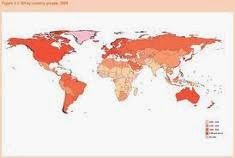
Contrary to what Bono claims the data is not "impossible track"--the UN data is pretty good in showing you the progress towards the goals through such items as interactive maps that show the passage of time regarding key indicators such as the number of people in the world who are living on $1 dollar a day in 2010 compared to 2000 when the MDG were first established:
But Obama is right the information is scattershot and not clearly presented so that a voter could see where his or her money went to what program and with what result.
Another part of the problem, perhaps a more important one, seems to be the media’s difficulty in reporting on long term stories. The TV news is much happier with reporting dramatic incidents and accidents than offering stories that require the perspective of time. When the politicians announce a the famous summits whether it be at “Monterrey in 2002 (to reach 0.7 per cent of GNP in development aid), Gleneagles in 2005 (to double African aid by 2010), L’Aquila in 2009 (to direct $22bn over three years to raise productivity of smallholder farming) and Copenhagen in 2009 (to add $30bn over three years for climate change adaptation and mitigation)” it captures the TV headlines but does not register. Nor does the story of why what these seemingly vast sums mean in terms of real change on the ground—better nutrition, less disease and how these amounts we are spending which are bare fractions of our GDP compare to the extent of the problem. President Obama clearly had in mind the country’s mood, to steer towards less foreign entanglements and less intervention, when he made his remarks before the UN General Assembly the other day concerning the MDG , 'With our economies struggling, so many people out of work, and so many families barely getting by, why a summit on development?' " Obama told an audience of several hundred people in the U.N. General Assembly hall. "The answer is simple. In our global economy, progress in even the poorest countries can advance the prosperity and security of people far beyond their borders, including my fellow Americans."
President Obama is right of course to frame the debate that way if it means gaining the support of the US Congress during a time of national austerity –but the media has to be able to help shape the story and tell the positive stories about International AID such as the Global Fund to Fight Aids, TB and Malaria, which argues Sachs is a better model than the MDG offers because it “pools resources from many donor nations, with an independent review board approving national programmes according to scientific and management criteria rather than bilateral politics. Educators must do their part too to keep up and explain the story that too many of our leaders and our media have failed to illuminate.
Does the entire process have to be re-thought so that it is more transparent and accountable? For example the Financial Times criticizes the Millenium Development Goals for being unrealistic
“Achieving universal primary education and halving the proportion of hungry people in 1990 was a daunting, if not impossible, task.”
Jeffrey Sachs avers that the system is “broken” and needs to be rethought.
“we must replace the fragmentation of bilateral programmes with a new strategy based on multi-donor pooled funding that has clear timelines, objectives and accountability.”
Bono a well known celebrity fighter for these goals (that he refers to as MDG) writing in the New York Times, thinks the record is better than Sachs and others are prepared to make out,
“Tens of millions more kids are in school thanks to debt cancellation. Millions of lives have been saved through the battle against preventable disease, thanks especially to the Global Fund to Fight AIDS, Tuberculosis and Malaria. Apart from fallout from the market meltdown, economic growth in Africa has been gathering pace — over 5 percent per year in the decade ending in 2009. Poverty declined by 1 percent a year from 1999 to 2005.”
Bono however, agrees with Sachs however that there is a greater need for transparency,
“Right now it’s near impossible to keep track. Walk (if you dare) into M.D.G. World and you will encounter a dizzying array of vague financing and policy commitments on critical issues, from maternal mortality to agricultural development. You come across a load of bureau-babble that too often is used to hide double counting, or mask double standards. This is the stuff that feeds the cynics.”
He recommends the creation of an independent unit “made up of people from governments, the private sector and civil society — to track pledges and progress, not just on aid but also on trade, governance, investment. It’s essential for the credibility of the United Nations, the M.D.G.’s, and all who work toward them.”
As the major western donors struggle with recession –a clear need is to help explain to the people why we need to care about these goals. Goals that did start out in 2000 as quite simple and obvious such as Goal 1 to eradicate poverty
Target 1:
Halve, between 1990 and 2015, the proportion of people whose income is less than $1 a day of poverty had diminished in almost every region
Target 2:
Achieve full and productive employment and decent work for all, including women and young people
Target 3:
Halve, between 1990 and 2015, the proportion of people who suffer from hunger
Contrary to what Bono claims the data is not "impossible track"--the UN data is pretty good in showing you the progress towards the goals through such items as interactive maps that show the passage of time regarding key indicators such as the number of people in the world who are living on $1 dollar a day in 2010 compared to 2000 when the MDG were first established:
But Obama is right the information is scattershot and not clearly presented so that a voter could see where his or her money went to what program and with what result.
Another part of the problem, perhaps a more important one, seems to be the media’s difficulty in reporting on long term stories. The TV news is much happier with reporting dramatic incidents and accidents than offering stories that require the perspective of time. When the politicians announce a the famous summits whether it be at “Monterrey in 2002 (to reach 0.7 per cent of GNP in development aid), Gleneagles in 2005 (to double African aid by 2010), L’Aquila in 2009 (to direct $22bn over three years to raise productivity of smallholder farming) and Copenhagen in 2009 (to add $30bn over three years for climate change adaptation and mitigation)” it captures the TV headlines but does not register. Nor does the story of why what these seemingly vast sums mean in terms of real change on the ground—better nutrition, less disease and how these amounts we are spending which are bare fractions of our GDP compare to the extent of the problem. President Obama clearly had in mind the country’s mood, to steer towards less foreign entanglements and less intervention, when he made his remarks before the UN General Assembly the other day concerning the MDG , 'With our economies struggling, so many people out of work, and so many families barely getting by, why a summit on development?' " Obama told an audience of several hundred people in the U.N. General Assembly hall. "The answer is simple. In our global economy, progress in even the poorest countries can advance the prosperity and security of people far beyond their borders, including my fellow Americans."
President Obama is right of course to frame the debate that way if it means gaining the support of the US Congress during a time of national austerity –but the media has to be able to help shape the story and tell the positive stories about International AID such as the Global Fund to Fight Aids, TB and Malaria, which argues Sachs is a better model than the MDG offers because it “pools resources from many donor nations, with an independent review board approving national programmes according to scientific and management criteria rather than bilateral politics. Educators must do their part too to keep up and explain the story that too many of our leaders and our media have failed to illuminate.
Wednesday, September 8, 2010
Problem Based Global Teaching
Global education is often a matter of bringing topical issues into the classroom in an engaging way that helps students appreciate the complexity of the world they live in. One way to help students realize that they are not just bystanders concerning the key questions that will affect their futures and potentially the fate of the planet is through problem based learning. Students often enjoy serious role play and particularly when they deal with scenarios involving today's headlines.
Students today with their ready access to all kinds of media and information are eager to part of not just a national but a global conversation and because of the Web 2.0 revolution they are primed to do so. After all it is their their blogs, their use of Digg and Twitter feeds, their YouTube uploads that are driving much of what
the media is now interested in writing about and vice versa. Those readers in the main happened to be under 30 and for schools to ignore the power of this transformation in our literacy and news consuming habits seems to be folly. Yet as Pew and other surveys routinely point out the Internet particularly in its Web 2.o form still tends to be viewed skeptically by schools.
But where and how to get started? Global education lends itself in my view to problem based learning, and to innovative uses of technology.
After all the issues related to global learning are ever changing and we have yet to come up with perfect textbook answers to respond to them. Clearly both of the last two facts tend to make teachers more nervous and less comfortable with the idea of including global education. The prevailing culture suggests that teachers need to know the answers and to be in control of the information. What to do?
My advice is to go slow and convince yourself that the old ways of doing business –teacher leading a lecture discussion with students textbook on text following along -- while comfortable and manageable are not working to prepare students for the 21st century world they actually inhabit. Employees don’t discover problems scattered around in textbooks, and answer sheets are nowhere to be found in the modern office. Workers collaborate and communicate online and form project teams that have goals and missions as they seek out evidence for their arguments. Apart from this the evidence suggests that students are bored out of their minds in the traditional settings and many of them simply tune out—and quietly rebel by failing to read set materials and “going through the motions” when it comes to responding to questions.In too many schools the situation is reminiscent of the old Soviet Union teachers pretend to teach and the students pretend to learn.
How to wake students up and engage them is tough—you have to find the right ways into the issues, but if you read newspapers with great world coverage like the New York Times on a regular basis you are sure to find on a fairly regular basis stories that can excite passions and energize conversations and most importantly of all--spark research and the kind of authentic learning that stays with the student long after the test is completed. Take this one I found in the New York Times magazine the other day. It is entitled the Peanut Butter Solution. The article tells the story of how a French pediatrician discovered a cure for child malnutrition and in doing so revealed the fault lines between the interests of free market western capitalism and those of the developing world. So this story can be educational in the best sense if teachers can find the time to think through how to use it in a classroom as a way to help students understand not just the way global economics works, but also the deeper moral questions that often get ignored by the media related to the need to respond to the continuing tragedy of global childhood malnutrition kills five million children a year and a third of all deaths of children under five. So the question for students after reading this is what would you do about the situation. Before they are able to answer that question it is a good idea for them to understand other points of view that they might not have entertained prior to answering that question. They can best do this through participating in a simulation.
After reading the New York Times article students might review an analogous set of facts involving patents in the case of HIV drugs that prior to the Clinton Foundation interventiuon were unaffordable for most of the developing world where the problem of HIV was most severe. This article has a good summary of the issues.
What would be an ideal set of activities for a unit like this? Perhaps a simulation like this:
Divide up the class in teams representing:
i) The French company that holds the patent.
ii) A country in a developing world that wants to develop the same kind of company as Paul Farmer in Haiti has done
iii) A US Peanut coalition that wants to manufacture and sell a peanut based product to the developing world.
iv) An international team of experts that is developing recommendations for what UNICEF, and World Patent bodies should do in regard to this issue.
Have each present their reports on why their views should prevail and argue their cases based on evidence that they have found in researching the issues. Have the international team of experts hear the cases being made and then in turn present their own findings. If one group wants to appeal have them present their case to another group of independent experts sitting in quasi judicial manner and have them write their report either upholding the intial recommendations or reversing them.
Provide a rubric on what kinds of evidence and arguments will be most favorably considered. Complete the assignment by asking the students to write how personally they would resolve the issues and the arguments and evidence they considered to reach their conclusion.
Sunday, August 29, 2010
Another Teachable Moment--The Ground Zero Mosque Controversy
How many teachers will use the recent NYC Ground Zero Mosque Controversy in their lessons I wonder? It is a difficult and sensitive issue to grasp particularly when the air has been made fairly radioactive by recent pronouncements from those right wingers who seek to use the issue to gain some personal partisan political advantage.
There are several entry points --among them the rights of religious minorities under the first amendment to practice their religion. I was reminded of George Washington's bold words in a letter to the Jews of Newport.
"The Citizens of the United States of America have a right to applaud themselves for giving to Mankind examples of an enlarged and liberal policy: a policy worthy of imitation. All possess alike liberty of conscience and immunities of citizenship. It is now no more that toleration is spoken of, as if it was by the indulgence of one class of people that another enjoyed the exercise of their inherent natural rights. For happily the Government of the United States, which gives to bigotry no sanction, to persecution no assistance, requires only that they who live under its protection, should demean themselves as good citizens."
Washington was the President of a new national government in 1787 when he wrote these words that have become central to the country's view of itself as a tolerant home to all believers. It is important to remember that at this time the monarchies across the European continent were still denying Jews their citizenship and economic livlihoods among other indiginities. Each year, Newport’s Congregation, now known as the Touro Synagogue where I visited and first read and was stirred by these words, re-reads Washington’s letter in a public ceremony.
Why not have these magnificent words re-read in every classroom, every year not just in the Touro synagogue--and hear them echo--"to bigotry no sanction, to persecution no assistance."?
Teachers could also compare the ways not just the Jews but Catholics had to struggle for their place in the country's polity. As Greevy and Appleby remind us "
"It took Catholics more than a full century to attain their current level of acceptance and influence, and they made their share of mistakes along the way, occasionally by trying too hard to prove their patriotic bona fides. (Exhibit A: Senator Joseph McCarthy, whose name is now, paradoxically, a synonym for “un-American activities.”) But they earned their place, over the course of many decades, by serving (and dying for) their country, and building their own churches, schools and health care systems alongside public counterparts, which they also frequented and supported with their taxes."
The New York of Review writers also point out that,
"Like many American Muslims today, many American Catholics squirmed when their foreign-born religious leaders offered belligerent or tone-deaf pronouncements on the modern world. New York’s own Bishop John Hughes thundered in 1850 that the Church’s mission was to convert “the officers of the navy and the Marines, commander of the Army, the legislatures, the Senate, the Cabinet, the president and all.” The Syllabus of Errors, promulgated by Pope Pius IX in 1864 denied that the Church had any duty to reconcile itself with “progress, liberalism, and modern civilization.”
In terms of media literacy the controversy could also allow students to dig into the real facts of the case which include that the idea for a community center dates back to December 2009, when (according to wikipedia) the religious leader Feisel Abdul Rauf "announced plans to build Cordoba House, a 13-story community center, including a mosque that would accommodate 1,000–2,000 Muslims in prayer, two blocks from Ground Zero. He won non-binding support from the local Community Board. He also received both support and opposition from some 9/11 families, politicians, organizations, academics, and others. The building of the mosque and community center, as well as the initiative itself, was supported by some Muslim American leaders and organizations, including CAIR, and criticized by some Muslims such as Sufi mystic Suleiman Schwartz, who said that a building built by Rauf barely two blocks from ground zero, is inconsistent with Sufi philosophy of simplicity of faith and sensitivity towards others. Supporters for Cordoba House point out that two mosques in Lower Manhattan have firm roots, and one of them was founded in 1970, pre-dating the World Trade Center.."
In other words the controversy is a lot more interesting than it might first appear and certainly highly teachable.
There are several entry points --among them the rights of religious minorities under the first amendment to practice their religion. I was reminded of George Washington's bold words in a letter to the Jews of Newport.
"The Citizens of the United States of America have a right to applaud themselves for giving to Mankind examples of an enlarged and liberal policy: a policy worthy of imitation. All possess alike liberty of conscience and immunities of citizenship. It is now no more that toleration is spoken of, as if it was by the indulgence of one class of people that another enjoyed the exercise of their inherent natural rights. For happily the Government of the United States, which gives to bigotry no sanction, to persecution no assistance, requires only that they who live under its protection, should demean themselves as good citizens."
Washington was the President of a new national government in 1787 when he wrote these words that have become central to the country's view of itself as a tolerant home to all believers. It is important to remember that at this time the monarchies across the European continent were still denying Jews their citizenship and economic livlihoods among other indiginities. Each year, Newport’s Congregation, now known as the Touro Synagogue where I visited and first read and was stirred by these words, re-reads Washington’s letter in a public ceremony.
Why not have these magnificent words re-read in every classroom, every year not just in the Touro synagogue--and hear them echo--"to bigotry no sanction, to persecution no assistance."?
Teachers could also compare the ways not just the Jews but Catholics had to struggle for their place in the country's polity. As Greevy and Appleby remind us "
"It took Catholics more than a full century to attain their current level of acceptance and influence, and they made their share of mistakes along the way, occasionally by trying too hard to prove their patriotic bona fides. (Exhibit A: Senator Joseph McCarthy, whose name is now, paradoxically, a synonym for “un-American activities.”) But they earned their place, over the course of many decades, by serving (and dying for) their country, and building their own churches, schools and health care systems alongside public counterparts, which they also frequented and supported with their taxes."
The New York of Review writers also point out that,
"Like many American Muslims today, many American Catholics squirmed when their foreign-born religious leaders offered belligerent or tone-deaf pronouncements on the modern world. New York’s own Bishop John Hughes thundered in 1850 that the Church’s mission was to convert “the officers of the navy and the Marines, commander of the Army, the legislatures, the Senate, the Cabinet, the president and all.” The Syllabus of Errors, promulgated by Pope Pius IX in 1864 denied that the Church had any duty to reconcile itself with “progress, liberalism, and modern civilization.”
In terms of media literacy the controversy could also allow students to dig into the real facts of the case which include that the idea for a community center dates back to December 2009, when (according to wikipedia) the religious leader Feisel Abdul Rauf "announced plans to build Cordoba House, a 13-story community center, including a mosque that would accommodate 1,000–2,000 Muslims in prayer, two blocks from Ground Zero. He won non-binding support from the local Community Board. He also received both support and opposition from some 9/11 families, politicians, organizations, academics, and others. The building of the mosque and community center, as well as the initiative itself, was supported by some Muslim American leaders and organizations, including CAIR, and criticized by some Muslims such as Sufi mystic Suleiman Schwartz, who said that a building built by Rauf barely two blocks from ground zero, is inconsistent with Sufi philosophy of simplicity of faith and sensitivity towards others. Supporters for Cordoba House point out that two mosques in Lower Manhattan have firm roots, and one of them was founded in 1970, pre-dating the World Trade Center.."
In other words the controversy is a lot more interesting than it might first appear and certainly highly teachable.
Friday, August 13, 2010
Globalization: A Very Short Introduction
The term "Globalization" is freighted down with multiple meanings. It is one of those words that are so large, abstract and all encompassing--very much like the word "education" or "culture" that can mean multiple things dependent on the context that the writer or speaker may or may not be fully aware of. One of the real benefits of Manfred Steger's Globalization: A Very Short Introduction (Oxford) is he introduces us to some of the most significant multiple meanings for the term and shows how and why the term is unavoidably a "contested one." Steger prefers to refer to the term as a "social condition" that is "characterized by a the existence of global, economic, political, cultural and environmental interconnections and flows that make many of the currently existing borders and boundaries irrelevant."
The term is interpreted by academics differently depending on their discipline and political disposition--some believe economics are at the core of the globalization, others believe political, cultural and ideological aspects, while others connect the term to environmental processes. He suggests that they are all guilty of the mistake of believing that globalization can be reduced to "a single domain that corresponds to their core expertise." Rather than going down the road of academic narcissism it is wiser to respect the varied and uneven ways globalization manifests itself--so that while various aspects of globalization have been present throughout history--it is "important to note the occurence of dramatic technological and social leaps that have pushed the intensity and global reach of these processes to new levels."
The short book is jammed full of good examples of how the uneven globalization forces work their magic in important ways today. Educators especially should pay close attention to a number of critical points Steger makes with respect to the ways globalization explodes our traditional view that nation states and home grown politicians and companies control our fates. A deeper understanding of globalization will reveal how more of the world's future is now subject to the interaction of global institutions and globalizing forces that are so powerful they cause sometimes massive political reactions. Reading this book can help educators see the sometimes yawning gaps in the picture of the world we portray to students. Some of the blank spaces include:
i) The diminished power of the state as a result of global corporations controlling as they do so much of the world's investment capital, technology and access to international markets are far more powerful than most states. Wal-Mart for example with sales of $166 billion surpasses the GDP of Poland, South Africa, Israel, Ireland and many other countries ad does Exxon, Shell, IBM and Siemens.
ii) The increasing power of international institutions such as the IMF, the World Bank and the World Trade Organization which are largely invisible from the eye of the media and hardly feature in most curriculums are largely responsible for controlling the power balance between rich and poor countries which largely runs on a north south basis.
iii) The increasingly important work of Non Governmental Organizations (NGOs) sometimes referred to as the "global civil society" like Amnesty International and Greenpeace that account for millions of active citizens throughout the world interceding in local as well as global political events.
iv) The ongoing clash between what Benjamin Barber has referred to as McWorld vs Jihad that has helped spawn Islamic terrorism as some extreme fundamentalist Muslims reject Western values carried so widely through the modern US dominated media outlets which they see as threatening the purity of their beliefs.
I found Steger most impressive on his critique of the ideological dimension of globalization--the assumption taken up by writers like Tom Friedman and politicians like Bill Clinton that globalization is an inevitable force that will benefit mankind and only needs free markets to enable this force to fully flourish around the world. Steger takes apart these naive view and criticizes globally controlled media outlets such as the Economist and the Wall Street Journal, Financial Times etc. for mindlessly subscribing to this ideological view. Steger acknowledges that what he refers to as "the globalists"--have the benefit of a "strong discourse" that is "notoriously difficult to resist and repel" --it is far from a water tight one and it would pay to actually look at the facts. It is not the case for example (as the globalists like to argue) that globalization has narrowed the gap between the richest and poorest countries. Using UN data he shows that while the income ratio between the richest and poorest countries in 1973 before the rapid onset of globalization was about 44:1 --in the remaining quarter century it had risen to 74:1.
Reading Steger's book can remind us that globalization is a force that can go in many directions and that it is dangerous if the term gets captured by one ideological group such as the globalists. His own view is expressed in the introduction:
"I believe we should take comfort in the fact that the world is becoming a more interdependent place that enhances people's chances to recognize and acknowledge their common humanity. I welcome the progressive transformation of social structures that goes by the name of globalization, provided that the the global flow of ideas and commodities and the rapid development of technology go hand in hand with greater forms of freedom and equality for all people, as well as the more effective protection of our global environment."
Good words and ones I can fully subscribe to. It is now up to educators to make this more open and more challenging view of globalization come alive in the classroom.
The term is interpreted by academics differently depending on their discipline and political disposition--some believe economics are at the core of the globalization, others believe political, cultural and ideological aspects, while others connect the term to environmental processes. He suggests that they are all guilty of the mistake of believing that globalization can be reduced to "a single domain that corresponds to their core expertise." Rather than going down the road of academic narcissism it is wiser to respect the varied and uneven ways globalization manifests itself--so that while various aspects of globalization have been present throughout history--it is "important to note the occurence of dramatic technological and social leaps that have pushed the intensity and global reach of these processes to new levels."
The short book is jammed full of good examples of how the uneven globalization forces work their magic in important ways today. Educators especially should pay close attention to a number of critical points Steger makes with respect to the ways globalization explodes our traditional view that nation states and home grown politicians and companies control our fates. A deeper understanding of globalization will reveal how more of the world's future is now subject to the interaction of global institutions and globalizing forces that are so powerful they cause sometimes massive political reactions. Reading this book can help educators see the sometimes yawning gaps in the picture of the world we portray to students. Some of the blank spaces include:
i) The diminished power of the state as a result of global corporations controlling as they do so much of the world's investment capital, technology and access to international markets are far more powerful than most states. Wal-Mart for example with sales of $166 billion surpasses the GDP of Poland, South Africa, Israel, Ireland and many other countries ad does Exxon, Shell, IBM and Siemens.
ii) The increasing power of international institutions such as the IMF, the World Bank and the World Trade Organization which are largely invisible from the eye of the media and hardly feature in most curriculums are largely responsible for controlling the power balance between rich and poor countries which largely runs on a north south basis.
iii) The increasingly important work of Non Governmental Organizations (NGOs) sometimes referred to as the "global civil society" like Amnesty International and Greenpeace that account for millions of active citizens throughout the world interceding in local as well as global political events.
iv) The ongoing clash between what Benjamin Barber has referred to as McWorld vs Jihad that has helped spawn Islamic terrorism as some extreme fundamentalist Muslims reject Western values carried so widely through the modern US dominated media outlets which they see as threatening the purity of their beliefs.
I found Steger most impressive on his critique of the ideological dimension of globalization--the assumption taken up by writers like Tom Friedman and politicians like Bill Clinton that globalization is an inevitable force that will benefit mankind and only needs free markets to enable this force to fully flourish around the world. Steger takes apart these naive view and criticizes globally controlled media outlets such as the Economist and the Wall Street Journal, Financial Times etc. for mindlessly subscribing to this ideological view. Steger acknowledges that what he refers to as "the globalists"--have the benefit of a "strong discourse" that is "notoriously difficult to resist and repel" --it is far from a water tight one and it would pay to actually look at the facts. It is not the case for example (as the globalists like to argue) that globalization has narrowed the gap between the richest and poorest countries. Using UN data he shows that while the income ratio between the richest and poorest countries in 1973 before the rapid onset of globalization was about 44:1 --in the remaining quarter century it had risen to 74:1.
Reading Steger's book can remind us that globalization is a force that can go in many directions and that it is dangerous if the term gets captured by one ideological group such as the globalists. His own view is expressed in the introduction:
"I believe we should take comfort in the fact that the world is becoming a more interdependent place that enhances people's chances to recognize and acknowledge their common humanity. I welcome the progressive transformation of social structures that goes by the name of globalization, provided that the the global flow of ideas and commodities and the rapid development of technology go hand in hand with greater forms of freedom and equality for all people, as well as the more effective protection of our global environment."
Good words and ones I can fully subscribe to. It is now up to educators to make this more open and more challenging view of globalization come alive in the classroom.
Monday, August 9, 2010
Tony Judt 1948-2001: Global intellectual
Tony Judt was one of a vanishing breed of public intellectuals who thought and wrote about hard subjecthttp://www.latimes.com/media/photo/2010-08/55415713.jpgs such as the fate of democracy,why we should oppose ideological fantasies of the 20th century and the prospects of peace in our late stage of capitalistic excesses.
His best known book, Post War: Europe since 1945, carefully showed the formation of a new Europe from the rubble of 1945 and intertwinned in the masterful narrative was the way many post war intellectuals have been trapped rather than liberated by some of the same ideologies that led to the last disastrous European war.
Judt died last week after a long and painful bout with Lou Gehrigs disease. He fought his tragic fate with enormous dignity and bravery, managing to use a specially adapted voice translator for his severely compromised lungs. Some fine obituaries have been penned this week. The one in The Guardian finely appreciates the contributions he made to modern European history and his effort to reframe the so called two state solution in the Middle East. His passing leaves a huge gap in our intellectual life. Let us hope that other brave independent minds can use his example and try to find a way of talking about the global issues that matter so they reach beyond just a narrow academic audience.
His best known book, Post War: Europe since 1945, carefully showed the formation of a new Europe from the rubble of 1945 and intertwinned in the masterful narrative was the way many post war intellectuals have been trapped rather than liberated by some of the same ideologies that led to the last disastrous European war.
Judt died last week after a long and painful bout with Lou Gehrigs disease. He fought his tragic fate with enormous dignity and bravery, managing to use a specially adapted voice translator for his severely compromised lungs. Some fine obituaries have been penned this week. The one in The Guardian finely appreciates the contributions he made to modern European history and his effort to reframe the so called two state solution in the Middle East. His passing leaves a huge gap in our intellectual life. Let us hope that other brave independent minds can use his example and try to find a way of talking about the global issues that matter so they reach beyond just a narrow academic audience.
Subscribe to:
Posts (Atom)