
Showing posts with label Billionaires. Show all posts
Showing posts with label Billionaires. Show all posts
Sunday, December 22, 2013
Signs of Hope at the End of 2013

Friday, March 22, 2013
Waging War on Corruption
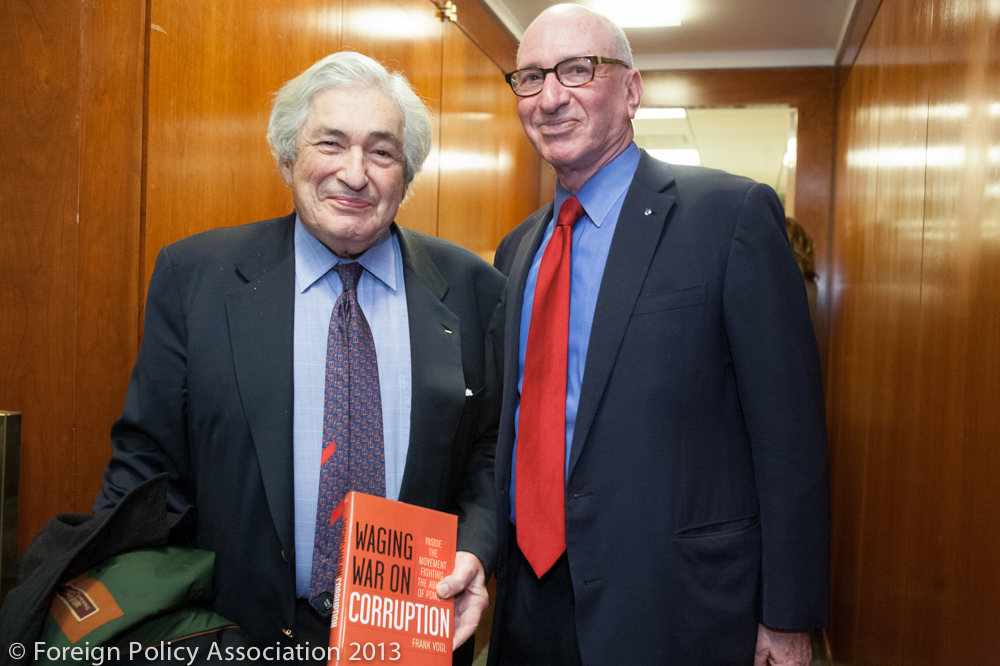 Frank Vogl first came to the US in 1974 to cover the Watergate scandal for the London Times.
He walked in on a moment in history that was to forever shape him as he discovered the mother of all corruption scandals was not contained by the romantic narrative that Woodward and Bernstein created and immortalized by the Alan Pakula movie, All the Presidents Men. The story he continued to follow continued long after Nixon resigned in shame and has not yet ended. It is a story of how not only a free press but civil society institutions like the one he co-founded Transparency International (TI) still need to identify corruption where it exists and name and shame those who commit these crimes. Vogl’s book makes for compelling reading because he gives us a large number of reasons why succcessfully going after corrupt officials matters to the well being of hundreds of millions of people around the world who although they may live in mineral rich countries find it difficult to feed themselves or keep their societies free from endless wars.
Frank Vogl first came to the US in 1974 to cover the Watergate scandal for the London Times.
He walked in on a moment in history that was to forever shape him as he discovered the mother of all corruption scandals was not contained by the romantic narrative that Woodward and Bernstein created and immortalized by the Alan Pakula movie, All the Presidents Men. The story he continued to follow continued long after Nixon resigned in shame and has not yet ended. It is a story of how not only a free press but civil society institutions like the one he co-founded Transparency International (TI) still need to identify corruption where it exists and name and shame those who commit these crimes. Vogl’s book makes for compelling reading because he gives us a large number of reasons why succcessfully going after corrupt officials matters to the well being of hundreds of millions of people around the world who although they may live in mineral rich countries find it difficult to feed themselves or keep their societies free from endless wars.This is a must read book for any student of foreign policy. Vogl points out that the aftermath of Watergate dragged on in the Committee rooms of Congress and exposed the extent of corrupt corruption involving US companies around the world. You become aware while reading the book how gigantic the problem of corruption really is despite Congress and various world bodies to curtail its spread. Vogl estimates that corruption forms perhaps 25 percent of Africa's GDP, or is ten times as great as the money flowing in foreign aid,. Vogl never loses sight of the human realities of corruption the untold human misery, suffering and death that it causes. This is the great strength of the book, to balance the political and institutional context in which corruption is allowed to breed with the human dramas. Vogl has had a cat bird seat in the battle against corruption and it shows in every word. Readers will be pleased to know that this is not one more miserable tale of how the world is going to hell in a handbasket. Vogl believes the war against corruption is winnable and provides good evidence for this in the book. The author himself has contributed to some clear progress in the fight, having co-founded Transparency International (TI) which has been credited for winning many battles in the long struggle to take this enemy of progress and civilization down.
The story of Watergate as Vogl points out did not have ended on the White House lawn with either Nixon’s departure by helicopter or Gerald Ford’s decision to pardon the former president but dragged on much of it without the public paying much attention. What Watergate revealed was the long list of corporations who had contributed to the Committee to Reelect the President (CREEP) through their subsidiaries were just a fraction of the bribes and payments that had been paid to a long list of government officials around the world. In other words Watergate was the tip of the tail of a huge dinosaur of global corrupt actions and practices that some of our most prestigious Fortune 500 companies were involved with including such luminaries as American Airlines, Lockheed, Ashland Oil and Goodyear. In the post Watergate era, Senator Frank Church, as Chairman of the Subcommitee on Multinational Companies decided despite the eagerness to move on and go back to business as usual to hold an unusually hard hitting set of hearings in which he placed on the witness stand the heads of these companies that had topped the CREEP contribution list. He managed to get on the record sizeable bribes that an assortment of companies had paid to corrupt dictators around the world. But their attitude towards reforming the system reflected much of the problem that it was the cost of doing business in these countries and they did see why they should be put at a disadvantage. It took bipartisan leadership to get the landmark legislation the Foreign and Corrupt Practices Act (FCPA) signed into law and only after business had received an amendment allowing for “faciitation payments’ did American business to reluctantly get on board and start working to get other countries to pass simllar laws or sign relevant international agreements.
Vogl follows the mixed reaction to the FCPA through the 1980s and early 1990s with high level institutions like the UN and the World Bank where Vogl worked at a senior level after he left the Times to fully embrace the new mentality. In fact most of the multilateral institutions felt that despite their efforts of economic aid and development ending up in too many cases in the Swiss bank accounts of dictators and felons that they were tilting at windmills to insist that basic rules should apply to the donating of money such as transparent accounting, respect for the rule of law. Well respected institutions like the World Bank had to find leaders who could effectively take their bureaucracies and the networked relationships they had with low and high level government officials and set them on a new path. As he points out the efforts of Wolfensohn at the World Bank ran into frequent roadblocks and unbelievable levels of cynicism. The UN had not helped itself with efforts to stamp out corruption when it was revealed that it was running its own corrupt oil for food program in the 1990s and had to confront the fall out from several other scandals. But to its credit in 1989 after the OECD had moved in the same direction Kofi Annan announced the launch of the UN Global Compact to “stimulate best practices in global corporate citizenship.” But then after Volker found huge abuses in the UN the General Assembly adopted the United Nations Convention Against Corruption (UNCAC) in 2003 and by 2009 140 countries had signed on. ut with so many countries that have shown little interest in enforcement (only a tiny number of people even in the US have gone to jail) the role for a monitoring body was clear and Vogl’s TI has stepped into the vacuum publishing its AntiCorruption Index which analyses the practices of 82 countries when it comes to corruption.
What is the cost of corruption? Vogl cites some statistics which give you more than a sense that the problem is gigantic, perhaps 25 percent of Africa’s GDP, or 10 times as great as the money flowing in foreign aid, but the true cost of corruption is described in terms of the human misery, suffering and death that it causes. This is the great strength of the book. Vogl is able to show the great inter-relationship between corruption, poverty and loss of human rights. Some of the most dire povery is found in countries that have vast mineral and oil and gas reserves. Sudan, Angola, Nigeria and Myanmar would be able to lift their people out of poverty if corruption was held in check. Vogl uses the example of the Democratic Republic of Congo (DRC) as perhaps the poster child for a kind of rampant murderous corruption that the world thought it saw the last of in the nineteenth century. On paper DRC has enough mineral wealth to feed its people and provide them with a western standard of living. but what has happened there should make us all weep. Just in the last handful of years 5.4 million people have died, half of those were children because of battles between war lords competing over the right to steal the country’s enormous wealth for their own purposes. International corporations are complicit arranging their secret deals and funneling the profits to the Swiss bank accounts of these brutal rulers. DRC also points up the fact that a country might proclaim itself democratic (as the DRC ironically does) but cannot function as a democracy without civil institutions and checks and balances for the executive branch. Vogl makes the case that we must tackle aid and development issues hand in hand with strengthening civil society. Vogl wants to paint despite the horror and destruction that corruption has caused around the world a hopeful picture. We may not be able to win the war on corruption at least not in one generation but we are well on our way to diminishing its pernicious effects across the globe. This is in part due to historical circumstances. With the end of the cold war there was less incentive for the Soviet Union and the US to basically bribe third world leaders with funds that allegedly went to economic development but in reality was funneled into the Swiss bank accounts of people like Marcos in the Phillipines and Somoza in Nicaragua.
The continued failure of mulitilateral institutions to demand more in the way of accountability or basic norms of law from receipent countries continues to irk Vogl. “The current model used by aid agencies is to try to get along with all kinds of regimes. They do not say there should be no money unless an independent judiciary is in place, unless there is press freedom, unless the people have the right to free assembly, or unless human rights are guaranteed.” They want to hold open the chance for incremental government reform “despite a record of failure.” As Vogl points out these funds come from you and I they are taxpayer funds and we should demand that they should go to the people who need the funds not for more limousines or weapons. His hope is that public pressure from Congress or elsewhere (maybe stimulated by the TI and other global transparency NGOs) will stop the circus once and for all. It is difficult to doubt Vogl’s conclusion that “there is an Everest of corruption still to climb.” The author believes that we are at last a base camp, no longer looking at the mountain and dreaming but ready for more decades of activism and to see the day when we finally turn the tide on this huge evil. He ends his magnicent account of the struggle with the hopeful words of civil rights advocate and author James Baldwin, “the people that once walked in the darkness are no longer prepared to do so.
Friday, February 15, 2013
Corporate Climate Denial is Now Endangering our Children's Futures
 So now we have the bitter truth we are in a race not just against the build up of carbon dioxide in our atmosphere but against the pollution industry and the billionaires who fund them. We already know that according to a recent report in The Guardian, "Conservative billionaires used a secretive funding route to channel nearly $120m (£77m) to more than 100 groups casting doubt about the science behind climate change..The funds, doled out between 2002 and 2010, helped build a vast network of thinktanks and activist groups working to a single purpose: to redefine climate change from neutral scientific fact to a highly polarising "wedge issue" for hardcore conservatives. The millions were routed through two trusts, Donors Trust and the Donors Capital Fund, operating out of a generic town house in the northern Virginia suburbs of Washington DC. Donors Capital caters to those making donations of $1m or more."
Now we see the work of these trusts manifest themselves in state laws that are determined to overturn science just as surely as early efforts tried to overturn the teaching of evolution. According to EcoWatch
"Oklahoma, Colorado and Arizona’s Legislatures are debating bills, all written by the pollution industry front group, the American Legislative Exchange Council (ALEC). The bills all refer to global warming as a “theory” and a “controversy” with scientific weaknesses. The Oklahoma bills say that students need to “develop critical thinking skills they need in order to become intelligent, productive and scientifically informed citizens.”
As we learn in this report, "ALEC is comprised of corporate lobbyists who write bills that well-greased lawmakers then introduce to Congress and State Legislatures nation-wide. ALEC gets most of its funding from the fossil fuel industry, and its interests are solely to protect the industry’s bottom line.
As Americans wake up to the reality of climate change, the corporate polluters responsible for global warming would prefer to put us back to sleep. They want us to lie in a warm blanket of cozy lies, and because their propaganda is not working as well with adults anymore, the polluters are targeting our children"
Where are we as a country when money buys this kind of influence over our children's minds? It is a time to stop this notion that the Supreme Court has advanced that money is speech. Money spent by corporations to influence legislatures is not speech it is propaganda to advance their own selfish interests at the expense of the rest of us and our future.
So now we have the bitter truth we are in a race not just against the build up of carbon dioxide in our atmosphere but against the pollution industry and the billionaires who fund them. We already know that according to a recent report in The Guardian, "Conservative billionaires used a secretive funding route to channel nearly $120m (£77m) to more than 100 groups casting doubt about the science behind climate change..The funds, doled out between 2002 and 2010, helped build a vast network of thinktanks and activist groups working to a single purpose: to redefine climate change from neutral scientific fact to a highly polarising "wedge issue" for hardcore conservatives. The millions were routed through two trusts, Donors Trust and the Donors Capital Fund, operating out of a generic town house in the northern Virginia suburbs of Washington DC. Donors Capital caters to those making donations of $1m or more."
Now we see the work of these trusts manifest themselves in state laws that are determined to overturn science just as surely as early efforts tried to overturn the teaching of evolution. According to EcoWatch
"Oklahoma, Colorado and Arizona’s Legislatures are debating bills, all written by the pollution industry front group, the American Legislative Exchange Council (ALEC). The bills all refer to global warming as a “theory” and a “controversy” with scientific weaknesses. The Oklahoma bills say that students need to “develop critical thinking skills they need in order to become intelligent, productive and scientifically informed citizens.”
As we learn in this report, "ALEC is comprised of corporate lobbyists who write bills that well-greased lawmakers then introduce to Congress and State Legislatures nation-wide. ALEC gets most of its funding from the fossil fuel industry, and its interests are solely to protect the industry’s bottom line.
As Americans wake up to the reality of climate change, the corporate polluters responsible for global warming would prefer to put us back to sleep. They want us to lie in a warm blanket of cozy lies, and because their propaganda is not working as well with adults anymore, the polluters are targeting our children"
Where are we as a country when money buys this kind of influence over our children's minds? It is a time to stop this notion that the Supreme Court has advanced that money is speech. Money spent by corporations to influence legislatures is not speech it is propaganda to advance their own selfish interests at the expense of the rest of us and our future.
Tuesday, January 11, 2011
Plutocrats Need to Decide the Future they Want for Themselves and the World in the 21st century

The lead article in this month's Atlantic by Chrystia Freeland of the Financial Times "The Rise of the New Ruling Class: How the Global Elite is Leaving You Behind" does not offer much in the way of new information about our increasingly isolated and entitled plutocratic class. We have known for a while that the economic meltdown was in part caused by a group of very well educated would be masters of the universe who newly equipped with turbo charged technology tools with money and access to the world's most powerful politicians, journalists and academics. That is why the global meltdown took everyone so much by surprise --I mean everyone! You knew that right? And why the deal that was arranged between the White House, the Congress, the Fed and Wall Street that bailed out the wrong doers was so quickly worked out away from the media spotlight.
What is new and interesting are the details--the quotes from the entitled that reconfirm that they feel victimized by having to pay a few percentage points more for their already grandiose lifestyles and their belief that it was the greed and ignorance of those who got locked into sub-prime mortgages and credit card debt that caused the meltdown. What is disturbing is that some of those most out of touch have working class origins--for example Goldman Sachs CEO Lloyd Blankfein is the son of a Brooklyn post office worker and Tony Hayward the disgraced Shell CEO has also blue collar roots. They all share along with their Russian plutocratic cousins a barely concealed sense of entitlement to not just modest rewards for a job well done but gargantuan ones. One of Freeland's informants comments about the change since the 1980s and 90s when “where there were men in their 30s and 40s making $2 and $3 million a year, and that was disgusting. But then you had the Internet age, and then globalization, and you had people in their 30s, through hedge funds and Goldman Sachs partner jobs, who were making $20, $30, $40 million a year. And there were a lot of them doing it. I think people making $5 million to $10 million definitely don’t think they are making enough money.” The executives featured in the article know the streets of Davos and Aspen where the rich and the famous gather with the rest of the global elite for their annual conferences better than their own neighborhoods. Many of them are as one CEO describes himself-"global nomads open to many perspectives." One of the perspectives is that the US is overpriced and that US businesses if they are going to be successful must "internationalize aggressively"--meaning they have to locate their businesses closer to their customers and that relatively high priced US workers must either take a pay cut
or demonstrate their superior value. One of the CEOs believe that if the price of three or four people in India or China to be lifted out of poverty is for a member of the US middle class to drop their living standards (read unemployed) then the price can be justified. It would be nice to believe they were saying these things because they genuinely wanted to help relieve poverty in Asia but it is doubtful. The real intention seems to be to want to bring the price of labor down everywhere so that profits can be more easily extracted. This maybe what Lloyd Blankfein was referring in his arrogant way to "doing God's work" when he tried to placate public outrage about his role and the role of brokerages like Goldman Sachs during the recent financial meltdown. If they truly believe that the world is better off with their version of global capitalism it would be great to subject these ideas to public debate, but as is so often the case these issues are never properly discussed except among their elite politician friends for whom they raise tremendous amounts of money for. Could we at least expect the media to ask the hard questions of our policymakers now that the public is beginning to discover the unfairness issue. Perhaps they could begin with the simple proposition that if we are to become in the US ten times more productive to successfully compete overseas and justify our more than subsistence level compensation--can the plutocrats give a little more back in taxes to create the kind educational and training opportunities for those most vulnerable to unemployment?
The problem in all this is even in a supercharged competitive global environment the oligarchs who bebenefited so richly from globalization seem blissfully unaware of the need to engage around these political and moral issues. Instead they seem to want more and more rewards for their efforts. It would not be so bad if the Wall Street world they inhabit bore any real relationship to the rest of the economy but like the Tulip crazes of a time ago the derivative markets in particular more closely resemble the casino hall as numerous other commentators have pointed out than they do a stock market. As Freeland remarks, "This plutocratic fantasy is, of course, just that: no matter how smart and innovative and industrious the super-elite may be, they can’t exist without the wider community. Even setting aside the financial bailouts recently supplied by the governments of the world, the rich need the rest of us as workers, clients, and consumers." Politicians and the media have sometimes indulged these fantasies and pretended otherwise glamorizing their outsized life styles and party-going in return for favors large and small. Freeland well the consequences of a world where the media and political elite mingle with plutocrats in meetings like Davos and a score of prestigious think tank events. How these gatherings tend to reinforce each others sense of huge privilege and entitlement. No wonder so many of them are prone to foot in the mouth "let them eat cake" type statements that will eventually in this new age of austerity force a political backlash that will begin a new round of protectionism. As Freeland points out that while "plutocrats’ opposition to increases in their taxes and tighter regulation of their economic activities is understandable, it is also a mistake. The real threat facing the super-elite, at home and abroad, isn’t modestly higher taxes, but rather the possibility that inchoate public rage could cohere into a more concrete populist agenda—that, for instance, middle-class Americans could conclude that the world economy isn’t working for them and decide that protectionism or truly punitive taxation is preferable to incremental measures such as the eventual repeal of the upper-bracket Bush tax cuts." It will be interesting to watch as the next decade unfolds how far this new global class are prepared to push the extremes. Do they really want to live lives ensconced within high security skyscrapers with their own helipads overlooking the slums where their fellow men and women eke out their daily living--is this what they regard as success in the 21st century? In case you don't believe this type of behavior is possible --take a closer look at the photograph at the top of this blog--it is the 27 storey "home" that Indian Billionaire Mukesh Ambani, that according to one report is "believed to be the most expensive home in the world" ….Located in Mumbai it overlooks the sprawling slums, and as well as a Cinema, Swimming Pools it has you guessed it a helicopter pad...maybe for a quick escape?
Subscribe to:
Posts (Atom)