Thursday, August 1, 2013

New Book Out! Planet in Peril: Young People to the Rescue

I am very pleased to announce the publication of my new book, Planet in Peril: Young People to the Rescue you can find it on Amazon Kindle among many other venues.Why did I write this book? First because the news headlines concerning the future can make young people especially if not the rest of us feel gloomy and even despondent about the future.

Young people in particular find it harder to separate off their own futures from the general gloom. While a gifted environmental science or social science teacher can give them a perspective on topics like global warming and the many calamities to come, too often the discussion is framed far too abstractly. I wrote this book because students need and want to comprehend their own role and place in this unfolding drama. Without understanding their own sense of agency students can all too often feel depressed and tune
out. But how do students gain this sense of agency? In my view it is through understanding people like themselves acting in the world and working to realize their own goals and following their own core values. My second reason for writing is that for a while now I have been frustrated by the gap between the rhetoric applied to various school reform initiatives and the reality. The rhetoric of why we must change our traditional teacher and text book centered classrooms and embrace more global realities has been in place at least since the cold war ended in the 1980s if not before. Yet despite the introduction of computers that can link any classroom to anywhere around the world, we have been relatively slow in using technology to exploring our global identities, preferring the safety and security of our still quite insular textbooks and the traditional approaches to the curriculum that they so often favor. The latest effort of our still quite insular textbooks and the traditional approaches to the curriculum that they so often favor.  A third and final reason for writing this book is my deep conviction that if we are truly to survive as a species we will need to be able to exhibit a new ethic of cooperation and collaboration that can surmount race and nationality. Young people I have met instinctively understand this and yet in their classrooms they are not shown enough people who may not look like them or sound like them who also want to make a difference on behalf of our common humanity. As the world gets smaller and we all get connected on Facebook and other social networks, we need to do more to show our young people the ways they can make a difference by using their voices to affect positive change in the world.

You can find the book at the following E-Reader Sites--

On Amazon


On Nook

Thursday, June 20, 2013

Sugata Mitra: We Are Just at the Beginning of Exploring the Web's Potential for Education

I have been following Sugata Mitra' work since I discovered his Hole in the Wall experiment in which he left a working computer in a hole in the wall of a remote Indian village and observed how the children taught themselves how to use the machine. This was ground breaking work that Mitra classifies under the academic sounding title 'self organized learning.'  The work provoked some mild interest and a spell binding TED talk that earned him a $1 million dollar prize in 2013 but not much else(as Mitra notes in a Guardian article) seems to have changed in the educational landscape. Mitra seems frustrated by the problem but has not stopped experimenting. His most recent innovation is the Granny Cloud--that has involved a group of volunteer teachers from the UK and a few other countries  who have been connecting to poor schools in India and South America for more than five years, "using a combination of the internet and admiration to provide a meaningful education for children."The grannies, or e-mediators as they are officially known, are not teachers, and the sessions they conduct with the children in India are not lessons. Instead, they read stories to the children and talk about things relevant to them and to the U.K. They encourage, praise and became a "virtual granny" to these Indian children. The granny idea emerged when after he saw students learning grow using the computer alone he brought in a " 22-year-old woman with no knowledge of the subject to tutor the kids, using “the method of the grandmother.” Instead of traditional instructing, she simply gave encouragement. The kids’ test comprehension scores jumped. There are around 300 "grannies" involved in the scheme and is growing all the time." What a good idea.  As Mitra states

"We don't need to improve schools. We need to reinvent them for our times, our requirements and our future. We don't need efficient clerks to fuel an administrative machine that is no longer needed. Machines will do that for us. We need people who can think divergently, across outdated "disciplines", connecting ideas across the entire mass of humanity. We need people who can think like children."

Mitra's major point is that we need to reinvent schooling based on the notion that the kind of superficial learning that school encourages can be mastered in a few minutes by children using the web


"The curriculum lists things that children must learn. There is no list stating why these things are important. A child being taught the history of Vikings in England says to me: "We could have found out all that in five minutes if we ever needed to."
What the Internet has really allowed in classrooms is what do we do with the knowledge once we find it ---how does it apply to real world problems. How can we devise new solutions. What does it mean for example that we are entering a period of planetary unsustainabilty?   We as teachers have been given a gift--we still seem to be struggling to know how to use it.


Wednesday, May 22, 2013

Google Takes Up A New Socially Useful Way of Harnessing their Profits and the Web


We live in an exciting age where good ideas can come from everywhere and anywhere not just from the ivy towers. The web can be used not just to gather the ideas but to enable them to go quickly to scale if they are designed correctly.  Google, Yahoo, AOL, Facebook etc etc maybe one of the first of a long line of innovations to transform the world. In later years we might be referring to these developments as those who transformed us into a socially and globally networked species, perhaps the most important transformations, led by such creations as Kickstarter will launch a new wave of socially useful ways to tap into that massive connectivity.  As web founder Sir Tim Berners-Lee,  has stated “The Web’s contribution to economic progress has been much celebrated, but I believe that we are only scratching the surface of its potential to solve social and political problems."Berners-Lee was among those who persuaded Google to set up a competition in which four organisations will be awarded   £2 million ($3 million) in the UK that are using technology for social good in areas like education, economic development, health, environment and community service. The challenge is being piloted in Britain ahead of a "global rollout" “Google believes technology can help solve some of the world’s most pressing challenges, and is eager to back innovators who are using technology to make an impact,” a spokesman said. Doubtless it is good for Google's PR image to be associated with something  so socially useful as  Tech Crunch states

"The Global Impact Challenge is an extension of the Global Impact Awards, $23 million award that Google gave out in December among seven non-profits using technology to solve world problems like clean water (charity:water) and endangered species (Consortium for the Barcode of Life).

A Google spokesperson says that the difference between that round of awards and this newest Global Impact Challenge is that the latter features a competitive element, with the prize open to any non-profit in the UK that chooses to apply. On the other hand, with the earlier grants, “there was no entry criteria, rather, [the] grants [were] awarded to exceptional orgs doing amazing things with tech.”

Now if Apple can be persuaded to follow Google's example and just a fraction of its profits that it parks off shore in shady accounts  then we might begin to see some impact. Go vote on the latest set of innovative ideas by clicking here!

Friday, April 5, 2013

Dictators Handbook: Why Bad Behavior Is Almost Always Good Politics

Since the dawn of history there have been no shortages of leaders who are prepared to do anything to stay in power. By “anything” we can include starving, torturing, stealing from and even slaughtering their own people, anything includes anything. We may want to believe that we live in an enlightened freedom loving world but for the peoples of Cambodia, Equatorial Guinea, North Korea, Mynama, Cambodia. Sudan and a host of others the future is as bleak as it ever was. These scoundrels are often assisted in their task of pillaging their country’s resources by a system of international aid and a belief that the “enemy of my enemy” is my friend that keeps these ruthless tyrants well supplied with US armaments designed to fight terrorism. Although de Mesquita and Smith’s thesis in The Dictators Handbook: Why Bad Behavior is Almost Always Good Politics is broader than a critique of the way the US and the international system it supports maintains these thugs. Its theme is that once the dictator. mob boss or even CEO is in power they have to follow some well entrenched rules or risk losing power. The preeminent among these is take care of those who brought you to the table first above all things or risk being deposed. Julius Ceaser forgot this basic rule when in his efforts to reduce the tax bite he got rid of tax farmers and destroyed the livings of many of his core supporters. There are many other interesting ancetdotes like this, from Carly Fiorina’s troubles as CEO of Hewlett Packard to “Big" Paul Castellano failed efforts to survive their enemies that give flavor to a highly readable book.  One of the features that make it such an easy read is the combination of  academic insights and "ripped from the headlines" inside stories of how corrupt dictators manage the game.

The takeaway is that good governance matters and there is a way to change our approach to the giving of aid so that we do not abet their egomanical desire to stay in power and force them rather to address the needs of their own people. But for any real efforts in this direction to begin we should give up our naive notions that foreign aid does anything more for the suffering people who are unfortunately locked inside the dictators’ prison walls. Despite the billions that have been given to countries’ where dictators rule there has been neglible impact for the simple reason the authors claim that autocrats believe money spent on “people-like infants and little children who are years away from contributing to the economy is money wasted. Resources should instead be focused on those who help the ruler stay in power now, not those who might be valuable in the distant future.” The difference in belief is shown by useful contrasts between where there is a commitment to democracy and where there is a flagrant disregard of it. Take Equataorial Guinea for example, with a per capita income of $37,000 a year can only provide 44 percent of its people with clean water. By contrast Honduras with a per capita income of only $4,100 can provide 95 percent of of its people enjoy potable water.

The authors conclude, “The availability and technology of clean water doesn’t favor democratic socieities; democratic regimes favor ensuring that drinking water is clean.” While many dictators do provide their people with a reasonable if basic education system and adequate health care that is because they need workers to be productive and pay taxes. Transportation systems may be more of an option since on the face of it new roads would increase productivity, the threat that a system of roads poses to a fortress like dictatorship can outweigh the benefits. Take Zaire’s Mobutu Sese Seko who once told the President of Rwanda that the reason why he never built one road despite staying in power for thirty years was he did not want them driving down his roads to get him. In fact so worried was he about the danger of roads that he made his life work destroying as many roads as possible. When he came to power in 1965 there were 90,000 miles of roads in Zaire, when he was finally deposed in 1997, 32 years later there were only 6,000 miles. Enough roads to take goods to market but not enough to make an armed uprising easy. Autocracy and corruption feed of each other much like symbiotic bacteria. According to Brookings Insitute’s Daniel Kaufman more than a trillion dollars is spent annually on bribes worldwide and much of that pocketed by government officials who live under dictators or the dictators themselves. Among the many features of the book that calls out for action is the discussion concerning the abuse of foreign aid.

If you want to get a lasting picture of how corrupt and ruthless these dictators are  you can take a look at what happened in Sri Lanka which suffered a massive earthquake followed by a tsunami that hit that country in December 2004  killing over 230,000 people across 14 nations. Assistance totalled over $14 billion contributed by people throughout the world. Oxfam sent 25 four wheel drive trucks to the region which the Sri Lankan government promptly impounded "insisting that Oxfam pay a 300 percent import duty. For over a month (the first critical month after the tsunami) the trucks sat idle and people went without food and shelter. Eventually Oxfam paid over a $1 million to have the trucks released."

Those who protest and fight against the obvious corruption find themselves in extreme danger. The dictators’ lifeblood is providing a source of riches to their most loyal supporters. Since the plunder is to be had not from their own citizens who they have for the most part bled dry they must gain the funds from the outside. The anti-corruption movement represents a large threat to their rule. Kaufman notes that the fate of some courgeous individuals who have joined the few anti-corruption commisions is that they are “either embattled or dead.” The leader can make no mistakes when dealing with dissent he must not give any signal to his core supporters that he can be toppled by being perceived as weak. Dictators constantly fear they will be deposed by an even more ruthless tyrant. But donors, most notably the World Bank, the IMF continue to cosy up to the dictators “like people so desperate to eat at a restuarant that they continued to ignore the health department warnings that the kitchen was overrun by rats.” The donors cannot pretend they are having the wool pulled over their eyes. When the IMF gave Kenya a $252.8 billion loan following the new president’s hollow promise to clean up corruption, the finance minister was whistling “pennies from heaven” and the new anti corruption minister had to flee to Britain carrying with him the tapes of how corrupt the new administration was. His information was ignored as whistleblowers routinely were in the circles where secrecy and non accountability is king. Nor can we have any illusions about the benefits bestowed by agencies like USAID which is more about advancing American foreign policy interests than about relieving poverty. If we ever wondered why we can never really make a dent in poverty we have to look not only at the World Bank and its fellow travellers as they turn a blind eye as the dictators siphon off cash and the western consultants and companies take their share, but to agencies like USAID.  They often provide a way for dictators to discharge themselves of their responsibility to feed the hungry and provide medical assistance due to weather emergencies etc so that they can better concentrate on their business of maintaining power. For example, half of Cambodia’s budget is made up of foreign aid. “Rather than supplementing government programs. these donor funds are largely directed toward the bank accounts of government officials.” Cambodia ranks among the world’s most corrupt countries. The USAID report notes that fact “a significant portion of funds earmarked for schools, teachers and textbooks and for clinics, health care workers and medications are diverted.” The NGOs are similarly taken advantage of and all these outside bodies the authors contend are “facilitating the government’s opportunity to steal more money..helping to further entrench a bad government in power to plague the people for many more years to come.”


What can be done? This is the subject of the last chapter and one that might be usefully read by all foreign policy students and future world bank bureacrats and aid executives. The danger is of course to become cynical and just put the entire miserable if not tragic history of aid down to the inevitable weakness built inside the human soul towards corrupt behavior. The anitidote is transparency and accountability, just like corporations that go off the rails when CEOs get drunk with power countries can do the same. In the case of companies it is frequently when the board and the shareholders lose track and a small proportion of them get wined and dined to go along. As the authors state we live in an age of networking. Much of the world although certainly not all of it is on Facebook or LinkedIn we can express our outrages at corportate excess--unjustified bonuses and the like in a more personal fashion using highly powerful social shaming techniques. For dictators who have armies the challenge is greater but by no means different. One of the reasons the Arab spring started in Tunisia is that the dictator there was concerned about a fall off in tourism. Tunisia had a relatively free press and the ability to assemble but tourism was a big ticket item and tourists wanted access to the internet and a feeling of less oppression. “Free assembly on line ..was translated into mass assembly in the streets.”

The authors see tourism as a key tool for helping to democratize countries--places like Kenya, Fiji and Palestine either are or want to become big tourist destinations. Aid does not just have to advance security interests it can be used more effectively as a tool for foreign policy--the aid needs to be contingent on criteria being met and “if the performance does not come up to agreed upon standards the money reverts to the donor.” We need to find more incentives for leaders to step down and the authors have no qualms in granting them immunity and keeping a portion of their ill gotten gains. The world is moving rapidly for the dictators --they cannot keep the lid on the ability to organize through cell phones and the internet forever. The Arab spring spells one hopeful sign that the era of dictators, one which thrived on isolation, ignorance and fear maybe coming to an end but it will take the concerted efforts of people who can pay attention and stand up for the injustices and outrages. It could all begin anywhere with someone carrying a simple device like a smart phone. Will we take the call?

Friday, March 22, 2013

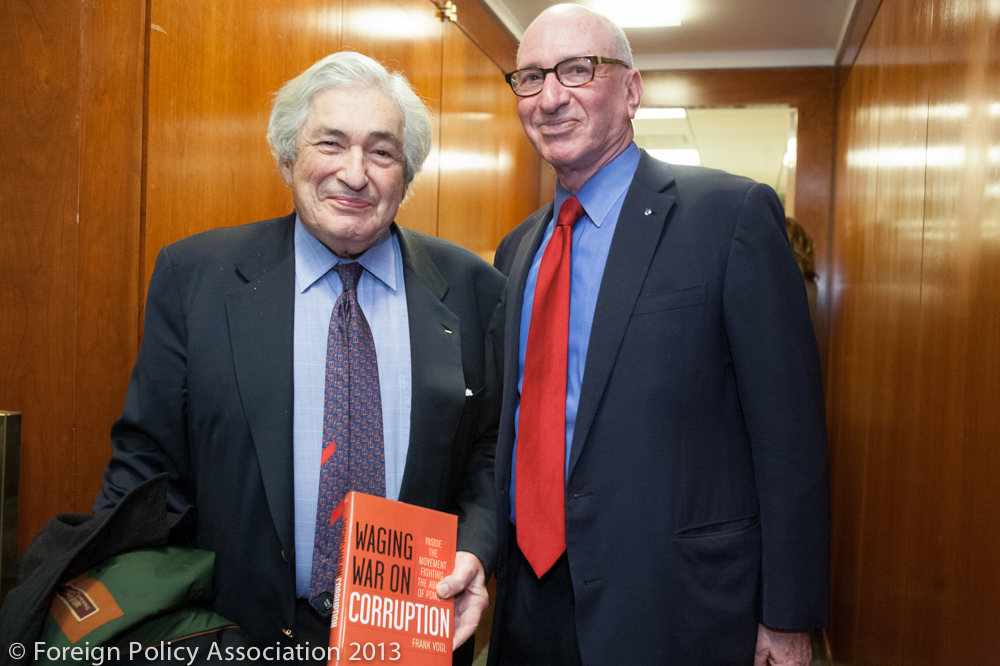
Waging War on Corruption

Frank Vogl first came to the US in 1974 to cover the Watergate scandal for the London Times. He walked in on a moment in history that was to forever shape him as he discovered the mother of all corruption scandals was not contained by the romantic narrative that Woodward and Bernstein created and immortalized by the Alan Pakula movie, All the Presidents Men. The story he continued to follow continued long after Nixon resigned in shame and has not yet ended. It is a story of how not only a free press but civil society institutions like the one he co-founded Transparency International (TI) still need to identify corruption where it exists and name and shame those who commit these crimes. Vogl’s book makes for compelling reading because he gives us a large number of reasons why succcessfully going after corrupt officials matters to the well being of hundreds of millions of people around the world who although they may live in mineral rich countries find it difficult to feed themselves or keep their societies free from endless wars.

This is a must read book for any student of foreign policy. Vogl points out that the aftermath of Watergate dragged on in the Committee rooms of Congress and exposed the extent of corrupt corruption involving US companies around the world. You become aware while reading the book how gigantic the problem of corruption really is despite Congress and various world bodies to curtail its spread. Vogl estimates that corruption forms perhaps 25 percent of Africa's GDP, or is ten times as great as the money flowing in foreign aid,. Vogl never loses sight of the human realities of corruption the untold human misery, suffering and death that it causes. This is the great strength of the book, to balance the political and institutional context in which corruption is allowed to breed with the human dramas. Vogl has had a cat bird seat in the battle against corruption and it shows in every word. Readers will be pleased to know that this is not one more miserable tale of how the world is going to hell in a handbasket. Vogl believes the war against corruption is winnable and provides good evidence for this in the book. The author himself has contributed to some clear progress in the fight, having co-founded Transparency International (TI) which has been credited for winning many battles in the long struggle to take this enemy of progress and civilization down. 


The story of Watergate as Vogl points out did not have ended on the White House lawn with either Nixon’s departure by helicopter or Gerald Ford’s decision to pardon the former president but dragged on much of it without the public paying much attention. What Watergate revealed was the long list of corporations who had contributed to the Committee to Reelect the President (CREEP) through their subsidiaries were just a fraction of the bribes and payments that had been paid to a long list of government officials around the world. In other words Watergate was the tip of the tail of a huge dinosaur of global corrupt actions and practices that some of our most prestigious Fortune 500 companies were involved with including such luminaries as American Airlines, Lockheed, Ashland Oil and Goodyear. In the post Watergate era, Senator Frank Church, as Chairman of the Subcommitee on Multinational Companies decided despite the eagerness to move on and go back to business as usual to hold an unusually hard hitting set of hearings in which he placed on the witness stand the heads of these companies that had topped the CREEP contribution list. He managed to get on the record sizeable bribes that an assortment of companies had paid to corrupt dictators around the world. But their attitude towards reforming the system reflected much of the problem that it was the cost of doing business in these countries and they did see why they should be put at a disadvantage. It took bipartisan leadership to get the landmark legislation the Foreign and Corrupt Practices Act (FCPA) signed into law and only after business had received an amendment allowing for “faciitation payments’ did American business to reluctantly get on board and start working to get other countries to pass simllar laws or sign relevant international agreements.

Vogl follows the mixed reaction to the FCPA through the 1980s and early 1990s with high level institutions like the UN and the World Bank where Vogl worked at a senior level after he left the Times to fully embrace the new mentality. In fact most of the multilateral institutions felt that despite their efforts of economic aid and development ending up in too many cases in the Swiss bank accounts of dictators and felons that they were tilting at windmills to insist that basic rules should apply to the donating of money such as transparent accounting, respect for the rule of law. Well respected institutions like the World Bank had to find leaders who could effectively take their bureaucracies and the networked relationships they had with low and high level government officials and set them on a new path. As he points out the efforts of Wolfensohn at the World Bank ran into frequent roadblocks and unbelievable levels of cynicism. The UN had not helped itself with efforts to stamp out corruption when it was revealed that it was running its own corrupt oil for food program in the 1990s and had to confront the fall out from several other scandals. But to its credit in 1989 after the OECD had moved in the same direction Kofi Annan announced the launch of the UN Global Compact to “stimulate best practices in global corporate citizenship.” But then after Volker found huge abuses in the UN the General Assembly adopted the United Nations Convention Against Corruption (UNCAC) in 2003 and by 2009 140 countries had signed on. ut with so many countries that have shown little interest in enforcement (only a tiny number of people even in the US have gone to jail) the role for a monitoring body was clear and Vogl’s TI has stepped into the vacuum publishing its AntiCorruption Index which analyses the practices of 82 countries when it comes to corruption.

 What is the cost of corruption? Vogl cites some statistics which give you more than a sense that the problem is gigantic, perhaps 25 percent of Africa’s GDP, or 10 times as great as the money flowing in foreign aid, but the true cost of corruption is described in terms of the human misery, suffering and death that it causes. This is the great strength of the book. Vogl is able to show the great inter-relationship between corruption, poverty and loss of human rights. Some of the most dire povery is found in countries that have vast mineral and oil and gas reserves. Sudan, Angola, Nigeria and Myanmar would be able to lift their people out of poverty if corruption was held in check. Vogl uses the example of the Democratic Republic of Congo (DRC) as perhaps the poster child for a kind of rampant murderous corruption that the world thought it saw the last of in the nineteenth century. On paper DRC has enough mineral wealth to feed its people and provide them with a western standard of living. but what has happened there should make us all weep. Just in the last handful of years 5.4 million people have died, half of those were children because of battles between war lords competing over the right to steal the country’s enormous wealth for their own purposes. International corporations are complicit arranging their secret deals and funneling the profits to the Swiss bank accounts of these brutal rulers. DRC also points up the fact that a country might proclaim itself democratic (as the DRC ironically does) but cannot function as a democracy without civil institutions and checks and balances for the executive branch. Vogl makes the case that we must tackle aid and development issues hand in hand with strengthening civil society. Vogl wants to paint despite the horror and destruction that corruption has caused around the world a hopeful picture. We may not be able to win the war on corruption at least not in one generation but we are well on our way to diminishing its pernicious effects across the globe. This is in part due to historical circumstances. With the end of the cold war there was less incentive for the Soviet Union and the US to basically bribe third world leaders with funds that allegedly went to economic development but in reality was funneled into the Swiss bank accounts of people like Marcos in the Phillipines and Somoza in Nicaragua.

 The continued failure of mulitilateral institutions to demand more in the way of accountability or basic norms of law from receipent countries continues to irk Vogl. “The current model used by aid agencies is to try to get along with all kinds of regimes. They do not say there should be no money unless an independent judiciary is in place, unless there is press freedom, unless the people have the right to free assembly, or unless human rights are guaranteed.” They want to hold open the chance for incremental government reform “despite a record of failure.” As Vogl points out these funds come from you and I they are taxpayer funds and we should demand that they should go to the people who need the funds not for more limousines or weapons. His hope is that public pressure from Congress or elsewhere (maybe stimulated by the TI and other global transparency NGOs) will stop the circus once and for all. It is difficult to doubt Vogl’s conclusion that “there is an Everest of corruption still to climb.” The author believes that we are at last a base camp, no longer looking at the mountain and dreaming but ready for more decades of activism and to see the day when we finally turn the tide on this huge evil. He ends his magnicent account of the struggle with the hopeful words of civil rights advocate and author James Baldwin, “the people that once walked in the darkness are no longer prepared to do so.

Wednesday, March 20, 2013

Wednesday, March 6, 2013

Steps Towards a SImple Learning Revolution

I have been a fan of Mitra's work for a few decades now and I am pleased to see how he has advanced his ideas from the Hole in the Wall computer to a SOLE concept to help transform learning world wide. SOLE stands for self organized learning and it is designed to put curiosity and mystery back into the learning process and take full advantage of the way children take to the computer and to the Internet without a lot of instruction. The computer seems now to be their natural learning medium. Instead of asking students to work out the tangent of an angle ask them to tell whether an asteroid is or is not on a path to hit earth. it is a simple design-- "Find a welcoming space for the children to share their stories of collective discovery. Facilitate a discussion about the question itself and their investigation process. Engage the kids in their own review" There does not have to be any tests. Just learning for the sake of learning under the kind supervision of a respectful encouraging adult. Here is the SOLE kit. Anyone can do it-- a teacher in a classroom, a parent who wants to home school or an after school supervisor. Let's help change the way people conceptualize what learning for the 21st century. The revolution begins here! Access the tool kit here