Friday, March 22, 2013

Waging War on Corruption

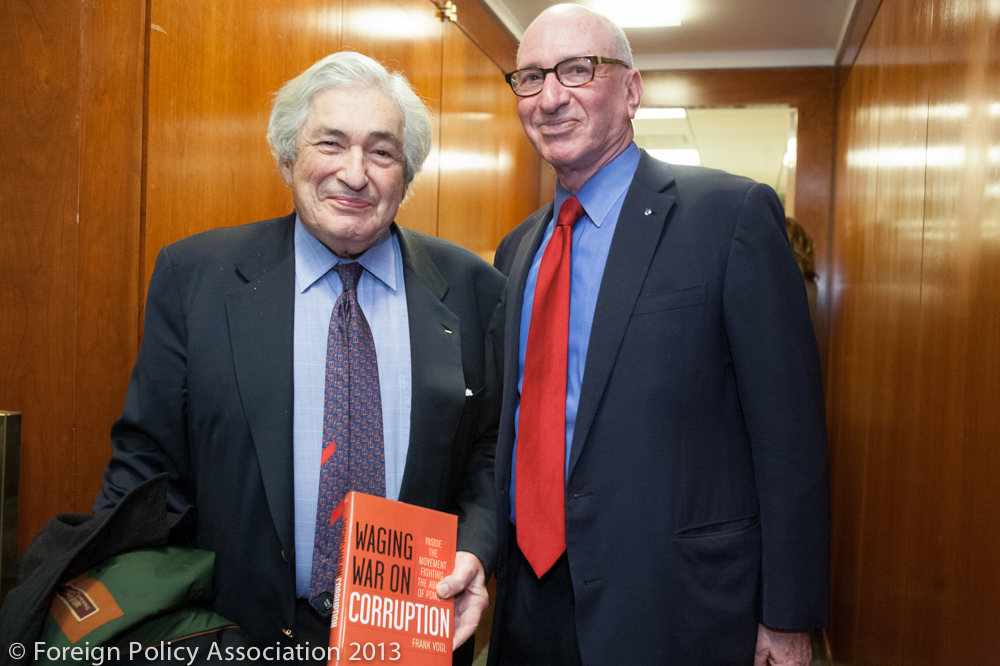
Frank Vogl first came to the US in 1974 to cover the Watergate scandal for the London Times. He walked in on a moment in history that was to forever shape him as he discovered the mother of all corruption scandals was not contained by the romantic narrative that Woodward and Bernstein created and immortalized by the Alan Pakula movie, All the Presidents Men. The story he continued to follow continued long after Nixon resigned in shame and has not yet ended. It is a story of how not only a free press but civil society institutions like the one he co-founded Transparency International (TI) still need to identify corruption where it exists and name and shame those who commit these crimes. Vogl’s book makes for compelling reading because he gives us a large number of reasons why succcessfully going after corrupt officials matters to the well being of hundreds of millions of people around the world who although they may live in mineral rich countries find it difficult to feed themselves or keep their societies free from endless wars.

This is a must read book for any student of foreign policy. Vogl points out that the aftermath of Watergate dragged on in the Committee rooms of Congress and exposed the extent of corrupt corruption involving US companies around the world. You become aware while reading the book how gigantic the problem of corruption really is despite Congress and various world bodies to curtail its spread. Vogl estimates that corruption forms perhaps 25 percent of Africa's GDP, or is ten times as great as the money flowing in foreign aid,. Vogl never loses sight of the human realities of corruption the untold human misery, suffering and death that it causes. This is the great strength of the book, to balance the political and institutional context in which corruption is allowed to breed with the human dramas. Vogl has had a cat bird seat in the battle against corruption and it shows in every word. Readers will be pleased to know that this is not one more miserable tale of how the world is going to hell in a handbasket. Vogl believes the war against corruption is winnable and provides good evidence for this in the book. The author himself has contributed to some clear progress in the fight, having co-founded Transparency International (TI) which has been credited for winning many battles in the long struggle to take this enemy of progress and civilization down. 


The story of Watergate as Vogl points out did not have ended on the White House lawn with either Nixon’s departure by helicopter or Gerald Ford’s decision to pardon the former president but dragged on much of it without the public paying much attention. What Watergate revealed was the long list of corporations who had contributed to the Committee to Reelect the President (CREEP) through their subsidiaries were just a fraction of the bribes and payments that had been paid to a long list of government officials around the world. In other words Watergate was the tip of the tail of a huge dinosaur of global corrupt actions and practices that some of our most prestigious Fortune 500 companies were involved with including such luminaries as American Airlines, Lockheed, Ashland Oil and Goodyear. In the post Watergate era, Senator Frank Church, as Chairman of the Subcommitee on Multinational Companies decided despite the eagerness to move on and go back to business as usual to hold an unusually hard hitting set of hearings in which he placed on the witness stand the heads of these companies that had topped the CREEP contribution list. He managed to get on the record sizeable bribes that an assortment of companies had paid to corrupt dictators around the world. But their attitude towards reforming the system reflected much of the problem that it was the cost of doing business in these countries and they did see why they should be put at a disadvantage. It took bipartisan leadership to get the landmark legislation the Foreign and Corrupt Practices Act (FCPA) signed into law and only after business had received an amendment allowing for “faciitation payments’ did American business to reluctantly get on board and start working to get other countries to pass simllar laws or sign relevant international agreements.

Vogl follows the mixed reaction to the FCPA through the 1980s and early 1990s with high level institutions like the UN and the World Bank where Vogl worked at a senior level after he left the Times to fully embrace the new mentality. In fact most of the multilateral institutions felt that despite their efforts of economic aid and development ending up in too many cases in the Swiss bank accounts of dictators and felons that they were tilting at windmills to insist that basic rules should apply to the donating of money such as transparent accounting, respect for the rule of law. Well respected institutions like the World Bank had to find leaders who could effectively take their bureaucracies and the networked relationships they had with low and high level government officials and set them on a new path. As he points out the efforts of Wolfensohn at the World Bank ran into frequent roadblocks and unbelievable levels of cynicism. The UN had not helped itself with efforts to stamp out corruption when it was revealed that it was running its own corrupt oil for food program in the 1990s and had to confront the fall out from several other scandals. But to its credit in 1989 after the OECD had moved in the same direction Kofi Annan announced the launch of the UN Global Compact to “stimulate best practices in global corporate citizenship.” But then after Volker found huge abuses in the UN the General Assembly adopted the United Nations Convention Against Corruption (UNCAC) in 2003 and by 2009 140 countries had signed on. ut with so many countries that have shown little interest in enforcement (only a tiny number of people even in the US have gone to jail) the role for a monitoring body was clear and Vogl’s TI has stepped into the vacuum publishing its AntiCorruption Index which analyses the practices of 82 countries when it comes to corruption.

 What is the cost of corruption? Vogl cites some statistics which give you more than a sense that the problem is gigantic, perhaps 25 percent of Africa’s GDP, or 10 times as great as the money flowing in foreign aid, but the true cost of corruption is described in terms of the human misery, suffering and death that it causes. This is the great strength of the book. Vogl is able to show the great inter-relationship between corruption, poverty and loss of human rights. Some of the most dire povery is found in countries that have vast mineral and oil and gas reserves. Sudan, Angola, Nigeria and Myanmar would be able to lift their people out of poverty if corruption was held in check. Vogl uses the example of the Democratic Republic of Congo (DRC) as perhaps the poster child for a kind of rampant murderous corruption that the world thought it saw the last of in the nineteenth century. On paper DRC has enough mineral wealth to feed its people and provide them with a western standard of living. but what has happened there should make us all weep. Just in the last handful of years 5.4 million people have died, half of those were children because of battles between war lords competing over the right to steal the country’s enormous wealth for their own purposes. International corporations are complicit arranging their secret deals and funneling the profits to the Swiss bank accounts of these brutal rulers. DRC also points up the fact that a country might proclaim itself democratic (as the DRC ironically does) but cannot function as a democracy without civil institutions and checks and balances for the executive branch. Vogl makes the case that we must tackle aid and development issues hand in hand with strengthening civil society. Vogl wants to paint despite the horror and destruction that corruption has caused around the world a hopeful picture. We may not be able to win the war on corruption at least not in one generation but we are well on our way to diminishing its pernicious effects across the globe. This is in part due to historical circumstances. With the end of the cold war there was less incentive for the Soviet Union and the US to basically bribe third world leaders with funds that allegedly went to economic development but in reality was funneled into the Swiss bank accounts of people like Marcos in the Phillipines and Somoza in Nicaragua.

 The continued failure of mulitilateral institutions to demand more in the way of accountability or basic norms of law from receipent countries continues to irk Vogl. “The current model used by aid agencies is to try to get along with all kinds of regimes. They do not say there should be no money unless an independent judiciary is in place, unless there is press freedom, unless the people have the right to free assembly, or unless human rights are guaranteed.” They want to hold open the chance for incremental government reform “despite a record of failure.” As Vogl points out these funds come from you and I they are taxpayer funds and we should demand that they should go to the people who need the funds not for more limousines or weapons. His hope is that public pressure from Congress or elsewhere (maybe stimulated by the TI and other global transparency NGOs) will stop the circus once and for all. It is difficult to doubt Vogl’s conclusion that “there is an Everest of corruption still to climb.” The author believes that we are at last a base camp, no longer looking at the mountain and dreaming but ready for more decades of activism and to see the day when we finally turn the tide on this huge evil. He ends his magnicent account of the struggle with the hopeful words of civil rights advocate and author James Baldwin, “the people that once walked in the darkness are no longer prepared to do so.

Wednesday, March 20, 2013

Wednesday, March 6, 2013

Steps Towards a SImple Learning Revolution

I have been a fan of Mitra's work for a few decades now and I am pleased to see how he has advanced his ideas from the Hole in the Wall computer to a SOLE concept to help transform learning world wide. SOLE stands for self organized learning and it is designed to put curiosity and mystery back into the learning process and take full advantage of the way children take to the computer and to the Internet without a lot of instruction. The computer seems now to be their natural learning medium. Instead of asking students to work out the tangent of an angle ask them to tell whether an asteroid is or is not on a path to hit earth. it is a simple design-- "Find a welcoming space for the children to share their stories of collective discovery. Facilitate a discussion about the question itself and their investigation process. Engage the kids in their own review" There does not have to be any tests. Just learning for the sake of learning under the kind supervision of a respectful encouraging adult. Here is the SOLE kit. Anyone can do it-- a teacher in a classroom, a parent who wants to home school or an after school supervisor. Let's help change the way people conceptualize what learning for the 21st century. The revolution begins here! Access the tool kit here

Friday, February 15, 2013

Corporate Climate Denial is Now Endangering our Children's Futures

So now we have the bitter truth we are in a race not just against the build up of carbon dioxide in our atmosphere but against the pollution industry and the billionaires who fund them. We already know that according to a recent report in The Guardian, "Conservative billionaires used a secretive funding route to channel nearly $120m (£77m) to more than 100 groups casting doubt about the science behind climate change..The funds, doled out between 2002 and 2010, helped build a vast network of thinktanks and activist groups working to a single purpose: to redefine climate change from neutral scientific fact to a highly polarising "wedge issue" for hardcore conservatives. The millions were routed through two trusts, Donors Trust and the Donors Capital Fund, operating out of a generic town house in the northern Virginia suburbs of Washington DC. Donors Capital caters to those making donations of $1m or more." Now we see the work of these trusts manifest themselves in state laws that are determined to overturn science just as surely as early efforts tried to overturn the teaching of evolution. According to EcoWatch "Oklahoma, Colorado and Arizona’s Legislatures are debating bills, all written by the pollution industry front group, the American Legislative Exchange Council (ALEC). The bills all refer to global warming as a “theory” and a “controversy” with scientific weaknesses. The Oklahoma bills say that students need to “develop critical thinking skills they need in order to become intelligent, productive and scientifically informed citizens.” As we learn in this report, "ALEC is comprised of corporate lobbyists who write bills that well-greased lawmakers then introduce to Congress and State Legislatures nation-wide. ALEC gets most of its funding from the fossil fuel industry, and its interests are solely to protect the industry’s bottom line. As Americans wake up to the reality of climate change, the corporate polluters responsible for global warming would prefer to put us back to sleep. They want us to lie in a warm blanket of cozy lies, and because their propaganda is not working as well with adults anymore, the polluters are targeting our children" Where are we as a country when money buys this kind of influence over our children's minds? It is a time to stop this notion that the Supreme Court has advanced that money is speech. Money spent by corporations to influence legislatures is not speech it is propaganda to advance their own selfish interests at the expense of the rest of us and our future.

Sunday, February 10, 2013

Can a Space Eye View of the Planet Change Us?

So if we want to leap forward and change consciousness we may need to take a trip into outer space Ross Pomeroy speculates in his latest Big Think piece. All we need to do is peer out the window as we see the earth--our beautiful spot of vivid blue floating serenely in a black cosmos. As Apollo 9 astronaut Russell Schweikart told self proclaimed space philosopher, Frank Wright "When you go around the Earth in an hour and a half, you begin to recognize that your identity is with that whole thing," ..That makes a change. You look down there and you can't imagine how many borders and boundaries you cross, again and again and again, and you don't even see them. There you are -- hundreds of people in the Mideast killing each other over some imaginary line that you're not even aware of, and that you can't see." To come up with a term to describe the emotion that is created and the change that seems to occur is hard. The "Overview Effect" does not seem quite right but it is in use for now. Now psychologists Melanie Rudd and Jennifer Aaker of Stanford University and Kathleen Vohs of the University of Minnesota are studying these "feelings of awe in a laboratory setting. They found that these moments made subjects feel like they had more time available, and that time itself was slowing down. This made them more patient, less materialistic, and more willing to volunteer to help others. Take a look at this short documentary and judge the effect for yourself.

OVERVIEW from Planetary Collective on Vimeo.

I am sure Richard Branson and other entrepreneurs will want to use footage like this to sell us on buying a ticket on the next shuttle trip. After all we do live in the 21st century. Of course for the cost of the ticket we might begin to solve some problems here on planet earth. Perhaps a trip to the local iMAX theater might be a good substitute.

Wednesday, January 16, 2013

Gun Violence: Lessons from South Africa

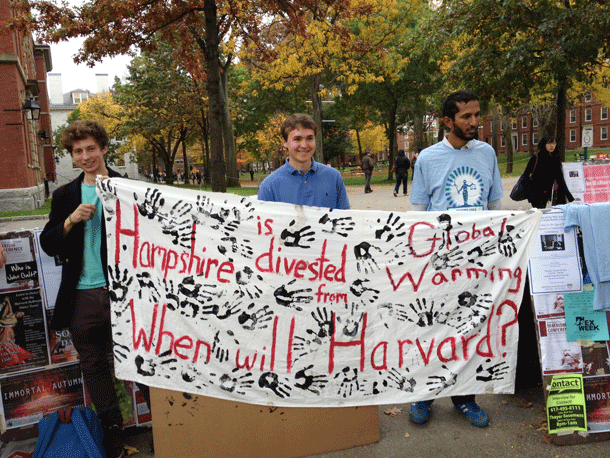
[The following piece is a guest blog that appeared on the Coalition to Stop Gun Violence website] In 1994, perhaps one of the most remarkable events of the 20th century occurred. The former leader of the anti-apartheid movement, Nelson Mandela, who was held captive for 27 years, was elected prime minister of South Africa. This peaceful handover of power was achieved not on the battlefield as many had feared, but because the world had divested from South African companies. This movement took time to grow and become mainstream, but grow it did, eventually going global. Picketing and demonstrations by student radicals on the campuses of the nations’ universities helped, but it was the attack on South Africa’s once vibrant white-dominated economy that really did the damage. In the 1980s, “between one-half and one-third of the S&P 500 did business in South Africa, placing these companies among the best investments at the time.” The amount of stock held by North American pension funds was minute compared to the size of these companies, but it was a game-changer when major colleges decided they could not morally stomach doing business with South Africa’s apartheid economy. By the end of the 1980s, “90 cities, 22 counties and 26 states [in the United States] had taken some form of economic stance against the South African government” and the divestment movement began to spread to other countries. Finally, the South African government got the message: “Continue to do business the same way and expect to be isolated as a pariah in the world community.” Now think about the contemporary American experience with gun violence. With our political leaders continuing to fail to make such basic changes to the law as outlawing assault weapons or banning cop-killer bullets, the anti-apartheid movement should give us confidence that we can still affect change. As Guardian reporter Brett Scott points out, “We’re used to the narrative of how weapons companies support lobby groups such as the National Rifle Association, but we're seldom encouraged to think about who funds the weapons companies themselves.” It’s us funding them, through our pension funds, as police officers, doctors, teachers, etc. Just as with the South African situation, the percentage of stock held individually by these funds in these companies is quite small, but collectively it is a significant stake. We, too, have the capability to send a powerful moral message that is clearly heard in boardrooms across America. This kind of thinking is beginning to provoke some large-scale changes. Announcements from pension funds around the country suggest that teachers are finally exerting their long-neglected power. Shortly after the Newtown tragedy, the California State Teachers’ Retirement System (the largest educator-only pension fund in the world) announced that it would review its investments in the national and international firearms business, including the $600 million it had invested in the private equity firm Cerberus Capital Management, which owns a significant chunk of the gun industry. Not coincidentally, on the same day Cerberus announced that it was divesting itself from its gun industry properties (Freedom Group International), including Bushmaster, the firm that manufactured the AR-15 rifle Adam Lanza used to kill 26 people at Sandy Hook Elementary School. Cerberus, however, has so far failed to act on its stock ownership of two of the largest gun manufacturers in the world Sturm, Ruger & Co. and Smith & Wesson Holding Corp. The movement is gaining its legs. The California action seems to be moving the New York State Teachers’ Retirement System to review its stake in Sturm, Ruger & Co. and Olin Corp, which manufactures Winchester Arms. Other interested parties taking a close look at their investments include Rhode Island Employees' Retirement System in Providence; Connecticut Retirement Plans and Trust Funds in Hartford; and the $37.5 billion Illinois Teachers' Retirement System in Springfield. What we now need is a national divestment movement to include the billions of dollars that state and municipalities across the country invest in firearm and ammunition manufacturers. Some pension fund managers will of course argue (as they have begun to do) that their role is not to decide the politics of the investments they make, but to simply serve fiduciaries. In other words, they claim their only mission is to ensure that members receive the highest return possible on their investments. But in a nation that suffers approximately 87 gun deaths per day, don’t they bear at least some level of responsibility for supporting the reckless marketing and sales practices of gun manufacturers? And even looking strictly at their financial argument, when bad publicity about gun manufacturers mounts following mass shootings tragedies like Newtown, these stocks are often highly volatile, and can create undisclosed legal liabilities. If you want another way to circumvent the bought-and-paid-for politicians who have refused to listen to rational arguments, you now have another way to make your voice heard. Call your local pension fund. Tell them you want them to divest 100% from investments in firearms and ammunition manufacturers. Working together, we can end the epidemic of gun violence in America. The divestment strategy worked in South Africa. It can work here, too. EMAIL THIS BLOGTHIS! SHARE TO TWITTER SHARE TO FACEBOOK

Sunday, December 23, 2012

Why Did the US Media Not Report this Article?

A woman was allowed to die in an Irish hospital because the doctors were not allowed by Irish law to perform an abortion. I did not know this story until I heard one of my favorite comedians report about it in one of his podcast monologues. First the story excerpted from the Guardian, here it is in stark terms: "The abortion ban came into international focus last month after an Indian woman, Savita Halappanavar, died in Galway university hospital during a miscarriage after she and her husband had repeatedly asked for a termination of her 19-week-old pregnancy. Her husband, Praveen, alleged that medical staff told them "this is a Catholic country" and that they would not carry out the termination." The only good thing to come out of this mess is that due to pressure from the European court there is a hope that a new law will be passed that will allow abortions to be allowed in "limited circumstances"to include where the life of the mother is threatened. Why is the US corporate controlled media not reporting this story?