In a recent New York Times op ed, Gyorgy Konrad reminds us about how quickly, even in our modern post Nazi German era, nationalistic politicians can move to uproot fundamental pillars of democracy.
Viktor Orban the prime minister has replaced the Hungarian Constitution with what he calls Basic Law. What asks Konrad is the point of this "crafty text"? Quite simple, he responds, "It aims to ensure that his rule is as lasting as that of the
quasi-fascist Miklos Horthy, from the 1920s to the 1940s, or that of the
communist Janos Kadar, who took over after the 1956 revolution and
ruled until 1988.
Gone now are intellectual freedoms and "our only independent radio station, with
hundreds of thousands of listeners — on a trumped-up pretext. Some of
its shows were critical of the government."
Listening to the Republican nominee attacks on the "media elite" and their ultra patriotism suggests that there is a similar lurking desire to move in the Hungarian direction.
Showing posts with label Democracy. Show all posts
Showing posts with label Democracy. Show all posts
Tuesday, January 24, 2012

Friday, February 4, 2011
Many More Teachable Moments from Egyptian Crisis Than Meet the Eye
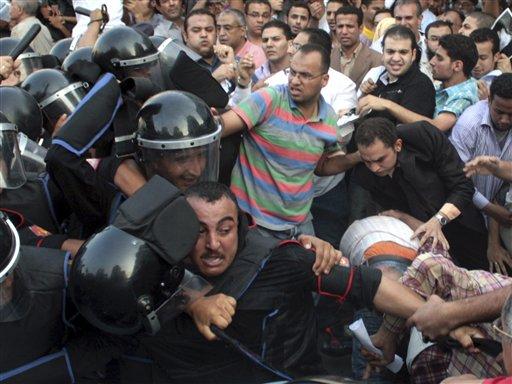
"According to the U.N. Human Development Index, .. one hundred and first, between Mongolia and Uzbekistan. In the context of the Arab Middle East, it ranks tenth, below not just rich countries like Kuwait and Saudi Arabia, but behind Libya, Jordan, and Algeria as well. According to Isobel Coleman of the Council on Foreign Relations, over the past decade, Egypt has experienced rising income inequality while failing to address root poverty. Ordinary Egyptians, she writes, simply not feel they were “reaping the benefits of [their country’s economic] expansion.” Food prices are rising to levels not seen since the global food crisis of 2007-2008, a recent World Bank study showed that the higher educational system is doing a very poor job of producing qualified graduates, and, whatever their qualifications, unemployment among the young is well over 30 percent nationally. "
"Washington seems never to have believed that any quid pro quo should have been demanded in return for the $28 billion USAID provided over the past 36 years. And yet, there is absolutely no reason why successive U.S. administrations should not have made this assistance conditional on, say, a serious attempt by the Egyptian government to curb corruption. It is not as if Mubarak would have then said, “That’s it, I’m breaking ties with Israel, lifting the Egyptian blockade of Gaza, and seeking a rapprochement with the Iranians.”
As Rieff goes onto argue things are worse in Pakistan--another major receipient of aid:
"According to a report issued this January by the International Federation of Red Cross and Red Crescent societies, more than four million people remain homeless six months after last year’s floods. And, in those regions, Islamist charities are often the only providers of medical services, shelter, and food that is not prohibitively expensive for most internally displaced people. And yet, while the U.S. government would certainly like to see something done (rather as it would have “liked” to see less corruption and torture in Egypt), it has not put anywhere near the pressure on the Pakistani government to alleviate these people’s suffering that it has in pushing Islamabad to escalate its military operations in the tribal areas of Pakistan along the Afghan border. "
When we send money for weapons and where we gain influence over those governments as a consequence we should not be pressured by the military so that they believe that these funds are there's
to keep. Nor should we take the Orwellian lies that our government then tells us about the ways those funds are supposed to be helping the economy more broadly. Rieff refers in particular to the
'' the grotesque claim that “USAID has helped Egypt become a “success story in economic development.” More specifically, the site claims particular success in improving the quality of education, and, the administration of justice,” improved “access to justice for disadvantaged groups..”
The only response to that type of whitewash is quite simply "garbage."
However the final situation in Egypt turns out the teachable moments coming out of the crisis are many and need to be taken seriously after CNN and all the world's news crews depart the scene and we move onto the next crisis. Understanding this crisis in more detail might help in fact avoid the next one.
Subscribe to:
Posts (Atom)