Showing posts with label UN. Show all posts
Thursday, November 21, 2013
Lack of Coverage of Warsaw Climate Conference Does Not Bode Well
The devastation from the recent typhoon that hit the Philippines according to the country's lead negotiator at the United Nations climate summit in Warsaw, Naderev Sano,“was [like] nothing we have ever experienced before, or perhaps nothing that any country has ever experienced before”.
Despite the thousands of people killed and Sano's plea to nations to act on climate change and prevent super typhoons such as Haiyan, from becoming “a way of life” the UN Conference on Climate change in Warsaw seems currently deadlocked.
The UN climate change summit going on now in Warsaw might as well be occurring on an alternative universe. There is no coverage in the mainstream press. The news today of a walk out among
"hundreds of environmental activists over the absence of a binding agreement on curbing global warming coming on the heels of a group of 133 developing nations walking out of a key negotiating meeting about how much of the burden developed economies must pay for the cost of the damage they have caused seems to suggest deadlock is now inevitable. According to one source
"The paper makes it clear that, despite President Barack Obama's progressive stances on climate issues over the past year, the US continues to pose difficulties to closing an international global climate deal by strongly resisting the concept of historical responsibility for emissions and positioning itself in opposition to developing countries on the main issues at stake."
The memo is indicative as to how many western governments are now turning their backs on climate change. As the Guardian has reported,
"Recent decisions by the governments of Australia, Japan and Canada to downgrade their efforts over climate change have caused panic among those states most affected by global warming, who fear others will follow as they rearrange their priorities during the downturn.
In the last few days, Japan has announced it will backtrack on its pledge to reduce its emission cuts from 25% to 3.8% by 2020 on the basis that it had to close its nuclear reactors after the 2011 earthquake and tsunami.
Australia, which is not sending a minister to this weekend's talks, signaled it may weaken its targets and is repealing domestic carbon laws following the election of a conservative government.
Canada has pulled out of the Kyoto accord, which committed major industrial economies to reducing their annual CO2 emissions to below 1990 levels.
These governments as well as the US have been allowed to get away with it by a compliant media that is owned in large part by corporate interests. If there is to be real change in terms of addressing the climate crisis it has to come from the grassroots. Even though the NGOs are walking out of Warsaw only after mobilizing a sleepy public and a negligent media.
Labels:
climate change,
Climate crisis,
NGOs,
Oxfam,
Philippines,
Typhoon,
UN
Wednesday, September 4, 2013
Is Obama Squandering his Legacy?
In July Obama visited Knox College in Galesburg Illinois and told the audience that he cared about “one thing and one thing only, and that’s how to use every minute of the 1,276 days remaining in my term to make this country work for working Americans again,” but now Obama is so boxed in with regard to Syria that it is highly unlikely that many of those days will now be devoted to delivering on that major goal. This will be unfortunate as the slow crisis that has been building since the implosion of the economy under reckless mismanagement by the former president, his friends on Wall Street and enablers in Congress, is now stealing the futures of the young. The portion of people aged 20-24 who have jobs has fallen from 72.2 percent in 2000 to just 61.5 percent, while adjusted for inflation, their median earnings has fallen by nearly 30 percent since 1973 and women, the median by 17 percent. Meanwhile the average net worth of the wealthiest seven percent of households climbed by 28 percent. The effects on the next generation will be even more severe. In 2011 nearly one third of all children lived in a household where no parent had full-time year round employment while half of all children in urban centers experience unstable family employment. As a recent ETS report points out “only Romania has a higher child poverty rate than the US." This is shameful for a nation that claims to be a world superpower. There is no use to pretending either that these numbers don't translate into significant gaps in achievement between rich and poor particularly in cities where continued segregation compounds the problem. As the recession continues income and educational equality will make the lives of poor families even worse as 26 states provide less funding per student to local school districts in the new school year than a year ago.
Syria is a huge distraction from the battle to focus people’s attention on unemployment and underemployment. A Syrian operation will likely cost several billion dollars just a few of those dollars could be spent to raise the minimum wage. How can you justify paying workers who support families wages that cannot support those families so that they have to apply for food stamps ? These are not handouts. The minimum wage in 1963 when Martin Luther King marched for jobs and justice was held constant for inflation it would now be $9.40 an hour in today’s dollars, not $7.25. Rather than wasting his political capital on rounding up Congress to authorize a dubious strike with a dubious legal basis he should be raising the minimum wage to reignite his flagging presidency. Doubtless MLK, Obama's hero, as he declared so passionately on the grounds of the Lincoln Memorial this month, would have supported the fast food workers. As their strikes move to more cities he could allow his inner MLK to sign an executive order to raise the minimum wage and rescue at least some of the workers caught in today's economic vice. On Syria he should follow Jane Harman’s advice and get Russia on our side, “If Russia would align with us on stopping all the butchery, that would be an important change, and Russia’s not there. For Russia to be on the wrong side of the use of chemical weapons is stunning, and we’re just not calling them out adequately. Our recent track record with Russia has not shown many results, but I think pulling the international community together to shame Russia is something we should be doing. We should use the leverage we have. The G20 is happening [September 5-6] in Russia. I would look at the G20 and at the United Nations General Assembly as two places where the international community comes together. It should be G19 against G1 going into Russia.”
For Obama to squander his last year and a half in this way will not help his legacy and set back the hopes of a generation.
Friday, March 22, 2013
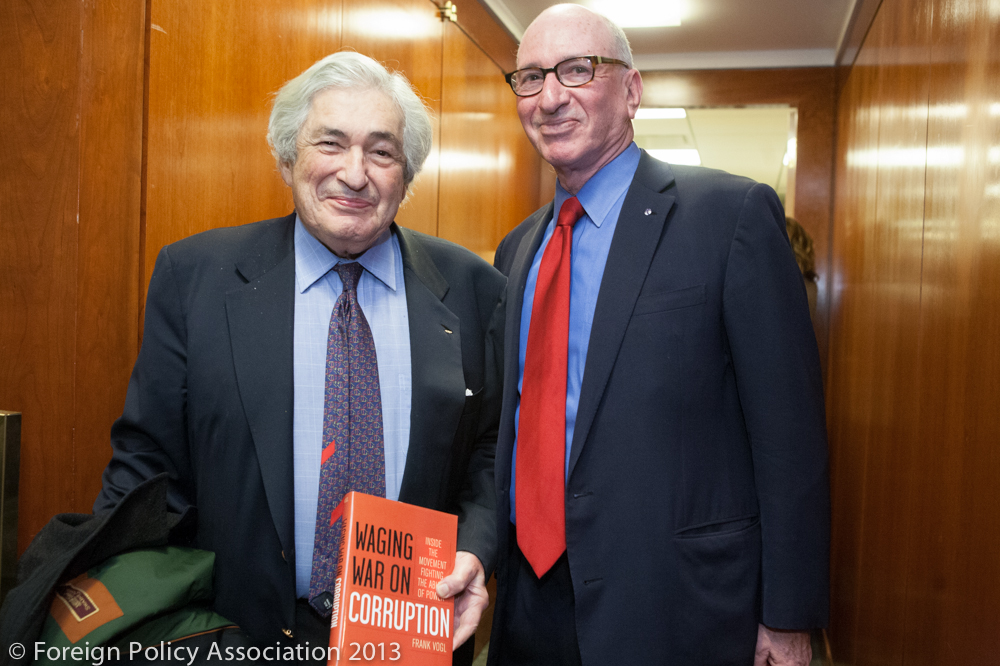
Waging War on Corruption
Frank Vogl first came to the US in 1974 to cover the Watergate scandal for the London Times.
He walked in on a moment in history that was to forever shape him as he discovered the mother of all corruption scandals was not contained by the romantic narrative that Woodward and Bernstein created and immortalized by the Alan Pakula movie, All the Presidents Men. The story he continued to follow continued long after Nixon resigned in shame and has not yet ended. It is a story of how not only a free press but civil society institutions like the one he co-founded Transparency International (TI) still need to identify corruption where it exists and name and shame those who commit these crimes. Vogl’s book makes for compelling reading because he gives us a large number of reasons why succcessfully going after corrupt officials matters to the well being of hundreds of millions of people around the world who although they may live in mineral rich countries find it difficult to feed themselves or keep their societies free from endless wars.This is a must read book for any student of foreign policy. Vogl points out that the aftermath of Watergate dragged on in the Committee rooms of Congress and exposed the extent of corrupt corruption involving US companies around the world. You become aware while reading the book how gigantic the problem of corruption really is despite Congress and various world bodies to curtail its spread. Vogl estimates that corruption forms perhaps 25 percent of Africa's GDP, or is ten times as great as the money flowing in foreign aid,. Vogl never loses sight of the human realities of corruption the untold human misery, suffering and death that it causes. This is the great strength of the book, to balance the political and institutional context in which corruption is allowed to breed with the human dramas. Vogl has had a cat bird seat in the battle against corruption and it shows in every word. Readers will be pleased to know that this is not one more miserable tale of how the world is going to hell in a handbasket. Vogl believes the war against corruption is winnable and provides good evidence for this in the book. The author himself has contributed to some clear progress in the fight, having co-founded Transparency International (TI) which has been credited for winning many battles in the long struggle to take this enemy of progress and civilization down.
The story of Watergate as Vogl points out did not have ended on the White House lawn with either Nixon’s departure by helicopter or Gerald Ford’s decision to pardon the former president but dragged on much of it without the public paying much attention. What Watergate revealed was the long list of corporations who had contributed to the Committee to Reelect the President (CREEP) through their subsidiaries were just a fraction of the bribes and payments that had been paid to a long list of government officials around the world. In other words Watergate was the tip of the tail of a huge dinosaur of global corrupt actions and practices that some of our most prestigious Fortune 500 companies were involved with including such luminaries as American Airlines, Lockheed, Ashland Oil and Goodyear. In the post Watergate era, Senator Frank Church, as Chairman of the Subcommitee on Multinational Companies decided despite the eagerness to move on and go back to business as usual to hold an unusually hard hitting set of hearings in which he placed on the witness stand the heads of these companies that had topped the CREEP contribution list. He managed to get on the record sizeable bribes that an assortment of companies had paid to corrupt dictators around the world. But their attitude towards reforming the system reflected much of the problem that it was the cost of doing business in these countries and they did see why they should be put at a disadvantage. It took bipartisan leadership to get the landmark legislation the Foreign and Corrupt Practices Act (FCPA) signed into law and only after business had received an amendment allowing for “faciitation payments’ did American business to reluctantly get on board and start working to get other countries to pass simllar laws or sign relevant international agreements.
Vogl follows the mixed reaction to the FCPA through the 1980s and early 1990s with high level institutions like the UN and the World Bank where Vogl worked at a senior level after he left the Times to fully embrace the new mentality. In fact most of the multilateral institutions felt that despite their efforts of economic aid and development ending up in too many cases in the Swiss bank accounts of dictators and felons that they were tilting at windmills to insist that basic rules should apply to the donating of money such as transparent accounting, respect for the rule of law. Well respected institutions like the World Bank had to find leaders who could effectively take their bureaucracies and the networked relationships they had with low and high level government officials and set them on a new path. As he points out the efforts of Wolfensohn at the World Bank ran into frequent roadblocks and unbelievable levels of cynicism. The UN had not helped itself with efforts to stamp out corruption when it was revealed that it was running its own corrupt oil for food program in the 1990s and had to confront the fall out from several other scandals. But to its credit in 1989 after the OECD had moved in the same direction Kofi Annan announced the launch of the UN Global Compact to “stimulate best practices in global corporate citizenship.” But then after Volker found huge abuses in the UN the General Assembly adopted the United Nations Convention Against Corruption (UNCAC) in 2003 and by 2009 140 countries had signed on. ut with so many countries that have shown little interest in enforcement (only a tiny number of people even in the US have gone to jail) the role for a monitoring body was clear and Vogl’s TI has stepped into the vacuum publishing its AntiCorruption Index which analyses the practices of 82 countries when it comes to corruption.
What is the cost of corruption? Vogl cites some statistics which give you more than a sense that the problem is gigantic, perhaps 25 percent of Africa’s GDP, or 10 times as great as the money flowing in foreign aid, but the true cost of corruption is described in terms of the human misery, suffering and death that it causes. This is the great strength of the book. Vogl is able to show the great inter-relationship between corruption, poverty and loss of human rights. Some of the most dire povery is found in countries that have vast mineral and oil and gas reserves. Sudan, Angola, Nigeria and Myanmar would be able to lift their people out of poverty if corruption was held in check. Vogl uses the example of the Democratic Republic of Congo (DRC) as perhaps the poster child for a kind of rampant murderous corruption that the world thought it saw the last of in the nineteenth century. On paper DRC has enough mineral wealth to feed its people and provide them with a western standard of living. but what has happened there should make us all weep. Just in the last handful of years 5.4 million people have died, half of those were children because of battles between war lords competing over the right to steal the country’s enormous wealth for their own purposes. International corporations are complicit arranging their secret deals and funneling the profits to the Swiss bank accounts of these brutal rulers. DRC also points up the fact that a country might proclaim itself democratic (as the DRC ironically does) but cannot function as a democracy without civil institutions and checks and balances for the executive branch. Vogl makes the case that we must tackle aid and development issues hand in hand with strengthening civil society. Vogl wants to paint despite the horror and destruction that corruption has caused around the world a hopeful picture. We may not be able to win the war on corruption at least not in one generation but we are well on our way to diminishing its pernicious effects across the globe. This is in part due to historical circumstances. With the end of the cold war there was less incentive for the Soviet Union and the US to basically bribe third world leaders with funds that allegedly went to economic development but in reality was funneled into the Swiss bank accounts of people like Marcos in the Phillipines and Somoza in Nicaragua.
The continued failure of mulitilateral institutions to demand more in the way of accountability or basic norms of law from receipent countries continues to irk Vogl. “The current model used by aid agencies is to try to get along with all kinds of regimes. They do not say there should be no money unless an independent judiciary is in place, unless there is press freedom, unless the people have the right to free assembly, or unless human rights are guaranteed.” They want to hold open the chance for incremental government reform “despite a record of failure.” As Vogl points out these funds come from you and I they are taxpayer funds and we should demand that they should go to the people who need the funds not for more limousines or weapons. His hope is that public pressure from Congress or elsewhere (maybe stimulated by the TI and other global transparency NGOs) will stop the circus once and for all. It is difficult to doubt Vogl’s conclusion that “there is an Everest of corruption still to climb.” The author believes that we are at last a base camp, no longer looking at the mountain and dreaming but ready for more decades of activism and to see the day when we finally turn the tide on this huge evil. He ends his magnicent account of the struggle with the hopeful words of civil rights advocate and author James Baldwin, “the people that once walked in the darkness are no longer prepared to do so.
Labels:
Billionaires,
Corruption,
Frank Vogl,
Politics,
UN,
Watergate,
World bank
Monday, January 9, 2012
Can the World Sustain Seven Billion People?
It comes down to this. If we want to build a sustainable world with 7 billion people on the
planet --emerging/developing economies will need to stop importing western lifestyles--because
if they adopt our high energy (carbon consuming) lifestyle it just wont work. Homi Kharas a Brookings expert
says as much in a recent video/podcast interview but what is interesting is that there is no real interest
in how to get that message across. Clearly the Indians and Chinese with their explosive growth and need
to create huge middle classes in their countries in order to stay politically stable and avoid totalitarian
extremes are not listening. We are not going to back away any time soon from our need to "strengthen the middle
class" and our desire to build more highways so we can buy more fuel guzzling cars. Where is the discussion about this fact
that unless we are serious about becoming a sustainable planet we are going to confront a huge ecological crisis?
The politicians and the media seem interested only in catering to short term needs. Where are the world bodies
the UN, the World Bank, other organizations to give us a global long term perspective on all this, where are the universities
and think tanks?
Friday, February 4, 2011
Many More Teachable Moments from Egyptian Crisis Than Meet the Eye
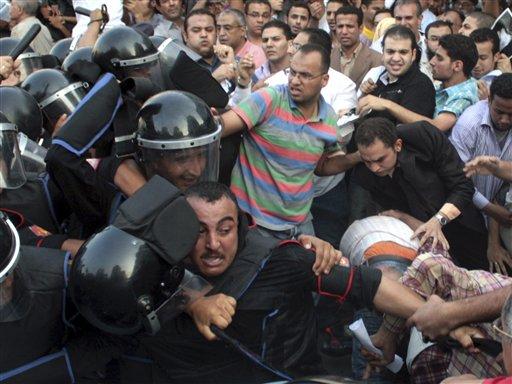
We have seen this movie before--thousands march into the streets against a brutal or at least ruthless dictator and we stand by applauding while moderately and never obnoxiously patting ourselves on the back for our love of freedom and democracy that we celebrate and believe is a universal value and what happens? Many times the revolution is crushed and we go back (after an seemly silence and rebukes) to going back to the way things always were. This pattern of events maybe the last of these episodes if we can encourage ourselves and our media to look more deeply at the pattern. The US as David Rieff points out in his excellent piece for the New Republic. Since 1975 as Rieff points out the US has given $23 billion in Aid to Egypt and still the country ranks..
"According to the U.N. Human Development Index, .. one hundred and first, between Mongolia and Uzbekistan. In the context of the Arab Middle East, it ranks tenth, below not just rich countries like Kuwait and Saudi Arabia, but behind Libya, Jordan, and Algeria as well. According to Isobel Coleman of the Council on Foreign Relations, over the past decade, Egypt has experienced rising income inequality while failing to address root poverty. Ordinary Egyptians, she writes, simply not feel they were “reaping the benefits of [their country’s economic] expansion.” Food prices are rising to levels not seen since the global food crisis of 2007-2008, a recent World Bank study showed that the higher educational system is doing a very poor job of producing qualified graduates, and, whatever their qualifications, unemployment among the young is well over 30 percent nationally. "
"Washington seems never to have believed that any quid pro quo should have been demanded in return for the $28 billion USAID provided over the past 36 years. And yet, there is absolutely no reason why successive U.S. administrations should not have made this assistance conditional on, say, a serious attempt by the Egyptian government to curb corruption. It is not as if Mubarak would have then said, “That’s it, I’m breaking ties with Israel, lifting the Egyptian blockade of Gaza, and seeking a rapprochement with the Iranians.”
As Rieff goes onto argue things are worse in Pakistan--another major receipient of aid:
"According to a report issued this January by the International Federation of Red Cross and Red Crescent societies, more than four million people remain homeless six months after last year’s floods. And, in those regions, Islamist charities are often the only providers of medical services, shelter, and food that is not prohibitively expensive for most internally displaced people. And yet, while the U.S. government would certainly like to see something done (rather as it would have “liked” to see less corruption and torture in Egypt), it has not put anywhere near the pressure on the Pakistani government to alleviate these people’s suffering that it has in pushing Islamabad to escalate its military operations in the tribal areas of Pakistan along the Afghan border. "
When we send money for weapons and where we gain influence over those governments as a consequence we should not be pressured by the military so that they believe that these funds are there's
to keep. Nor should we take the Orwellian lies that our government then tells us about the ways those funds are supposed to be helping the economy more broadly. Rieff refers in particular to the
'' the grotesque claim that “USAID has helped Egypt become a “success story in economic development.” More specifically, the site claims particular success in improving the quality of education, and, the administration of justice,” improved “access to justice for disadvantaged groups..”
The only response to that type of whitewash is quite simply "garbage."
However the final situation in Egypt turns out the teachable moments coming out of the crisis are many and need to be taken seriously after CNN and all the world's news crews depart the scene and we move onto the next crisis. Understanding this crisis in more detail might help in fact avoid the next one.
Subscribe to:
Posts (Atom)